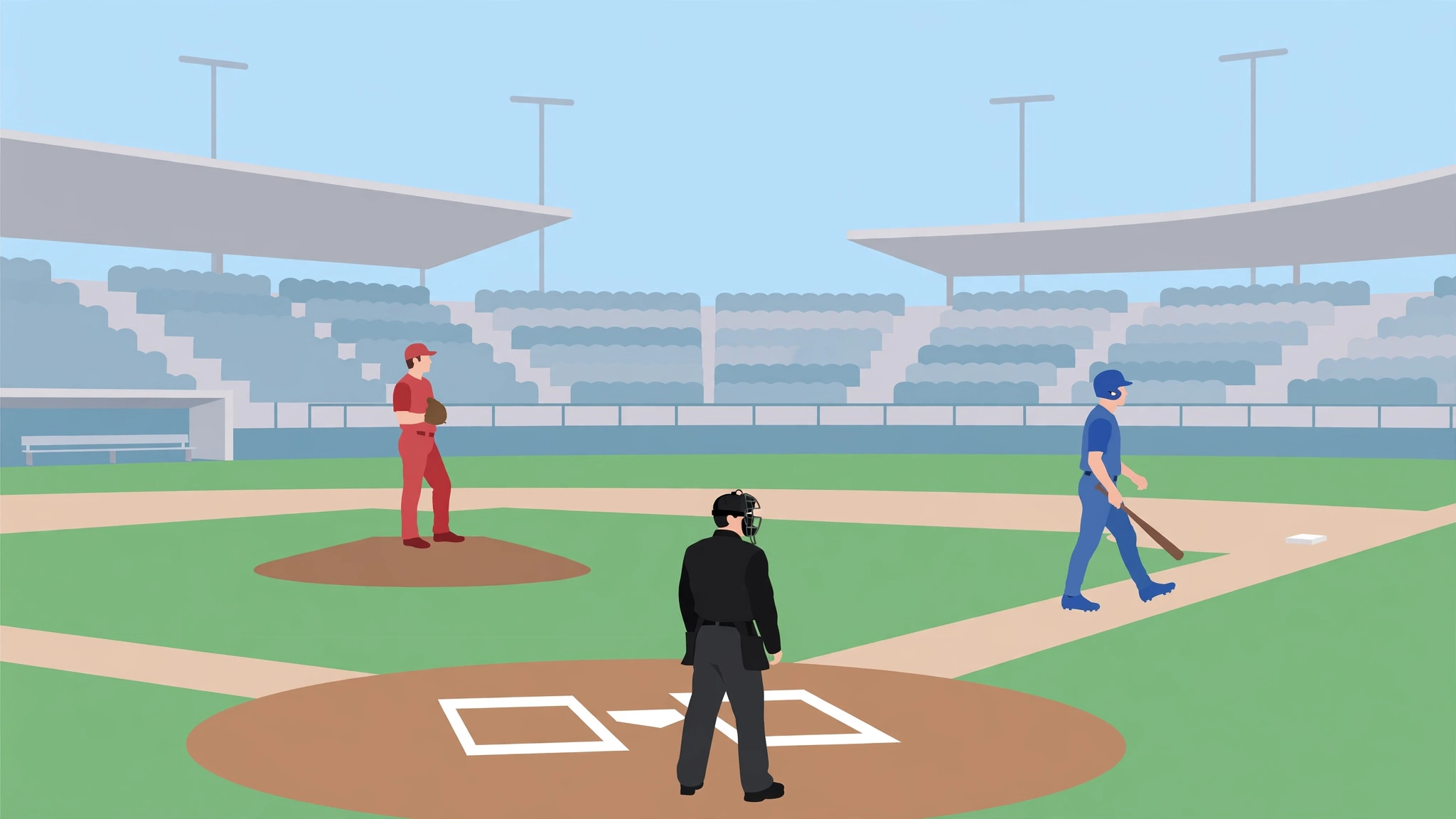
In a baseball box score, BB means a base on balls — better known as a walk.
When a pitcher throws four pitches outside the strike zone and the batter does not swing, the batter drops the bat and trots to first base, free of charge. That is a BB. It shows up twice in every box score: the walks each batter earns, and the walks each pitcher allows.
Umpires never shout it and scoreboards rarely flash it, but BB quietly shapes games, statistics, and reputations.
The key takeaway: BB is the official shorthand for a walk — four balls, first base, no swing required.
What does BB mean in baseball?
BB is the scorekeeper’s two-letter code for base on balls, the rulebook name for a walk. A “ball” is a pitch outside the strike zone that the batter does not swing at; collect four in one plate appearance and first base is yours. Here is where you will meet the code:
| Where you see BB | What it counts | How to read it |
|---|---|---|
| A batter’s line | Walks the batter earned | “BB: 2” means he walked twice — a sign of a patient eye. |
| A pitcher’s line | Walks the pitcher allowed | “BB: 4” means four free passes — a sign of wildness. |
| Season statistics | Total walks, and rates built from them | Batters chase high walk totals; pitchers chase low ones. |
| IBB | Intentional base on balls — a walk ordered on purpose | The manager skips the pitches and sends the batter straight to first. |
The same letters guard one important secret: a walk is not a hit, and it does not count as an at-bat. It is a plate appearance that raises a batter’s on-base percentage without touching his batting average — patience, recorded.
Where does BB come from?
“Base on balls” is the official phrase, and it is nearly as old as professional baseball itself. Early rules were generous: in the 1870s a batter needed nine balls before earning first base. The number shrank through the 1880s — pitchers were gaining the upper hand — and in 1889 it settled at four balls, where it has stayed ever since. Scorekeepers, who once recorded games in pencil in tight columns, compressed phrases into codes: H for hit, SO or K for strikeout, and BB for the base on balls. The abbreviation outlived the pencil; every website and broadcast graphic still uses it today.
How BB appears in real games and sentences
Three natural examples — a headline, a box score, and a broadcast line:
“Trailing by one in the ninth, she worked a BB on a full count and set up the winning run.”
“His line for the night read 2-for-4 with a double and two BB — he was on base all evening.”
“The young pitcher struck out nine but issued five BB, and those free passes cost him the game.”
Reading a pitcher’s BB column is the fastest health check in the box score: strikeouts excite us, but walks decide whether a pitcher trusts his own stuff.
Similar baseball terms to BB
- Walk — the everyday name for the same play; BB is the box-score spelling of it.
- Free pass — the broadcasters’ nickname, because the batter reaches base without hitting anything.
- IBB (intentional walk) — a walk ordered by the manager; since 2017, Major League teams simply signal it and no pitches are thrown.
- HBP (hit by pitch) — the neighbour that is not a walk: a pitch that hits the batter also sends him to first, but is recorded separately, with no balls counted.
- Plate appearance — the umbrella count: at-bats plus walks, hit-by-pitches and sacrifices. Every BB lives here but never in at-bats.
When you will meet BB — and what to watch for
Expect BB whenever:
- You read a box score, a player’s statistics page, or a fantasy baseball report.
- Analysts judge a young hitter’s “eye” or a pitcher’s command — walks are the measuring tape.
- Managers play strategy: an intentional BB can set up a double play or dodge a dangerous slugger.
Keep these distinctions straight:
- A BB is not a hit and not an at-bat, so it cannot lower a batting average — a 0-for-2 night with two walks was a good night.
- BB differs from HBP: four balls require patience, one plunk requires only standing close.
- In play-by-play shorthand a lone “B” sometimes marks a single ball thrown; the double BB is reserved for the finished walk.
FAQs about BB in baseball
What does BB mean in simple words?
BB is short for “base on balls,” the walk. Four pitches miss the strike zone, the batter does not swing, and he is awarded first base. On a batter’s record BB counts his walks; on a pitcher’s, the walks he allowed.
Is a walk (BB) counted as a hit or an at-bat?
Neither. A walk is a plate appearance but not an at-bat, and certainly not a hit — which is why it cannot hurt a batting average, yet still improves the player’s on-base percentage.
What is the difference between BB and HBP?
Both end with the batter on first base. A BB is earned by taking four balls outside the zone; an HBP means a pitch actually hit the batter. They are counted in separate columns, and pitchers would rather allow neither.
What does IBB mean?
IBB is an intentional base on balls: the defence chooses to walk a batter on purpose, usually to face a weaker hitter next or set up a double play. Since 2017 in the major leagues the manager simply signals, and the batter goes to first without a pitch.
Why do pitchers walk batters on purpose?
Strategy. An intentional walk can dodge a feared slugger, fill first base so a double play becomes possible, or line up a better pitching matchup. It trades one free base for a situation the defence prefers.
Final thoughts on BB
BB is two letters carrying 150 years of scorekeeping: patience rewarded, wildness punished, whole games quietly tilted. Once you can read that column, the rest of the box score starts making sense.
BB means base on balls — a walk: four balls, first base, and statistics that never forget it.

Hi, I’m Daniel Pierce, a writer at Symboliism.com who specializes in love symbols, relationship numbers, and their hidden meanings. I break down romantic signs, soulmate numbers, and emotional symbolism in a simple, relatable way. My goal is to help readers understand the deeper messages behind love, connection, and the symbols that guide our relationships.