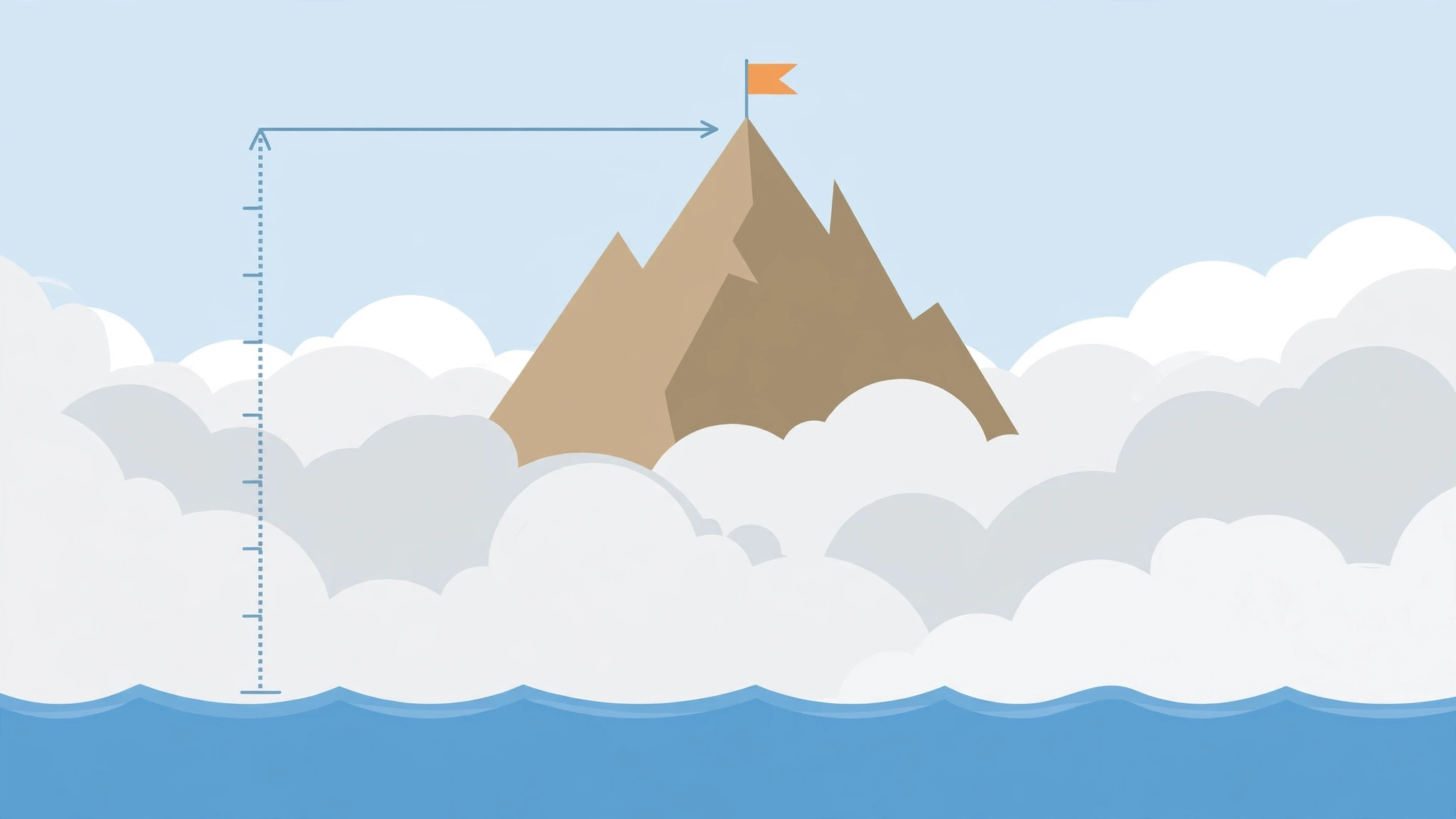
Elevation is height measured against the sea. That is the quick answer: a place’s elevation is how far above mean sea level it sits — Denver at exactly one mile, Everest near the top of the world. But the word also climbs ladders (“his elevation to managing director”), and architects use it for the flat drawing of a building’s face. Land, ladder, and drawing board: three worlds wearing one tall word. The key takeaway: elevation means height above sea level, a rise in rank, or a building’s front view on paper.
What does elevation mean?
Start with the ground beneath you. Every solid point on Earth has an elevation, measured from the level of the sea — even places below it, which surveyors cheerfully record as negative numbers. The other two senses grew from the simple picture of being raised up:
| Sense | What it means | Simple example |
|---|---|---|
| Geography | How high land or a place stands above sea level | “Denver’s elevation is 1,609 metres — one mile up.” |
| Position and rank | A rise to a higher office or status (formal) | “Her elevation to the board surprised nobody.” |
| Architecture | A flat, to-scale drawing of one side of a building | “The plans show the front elevation with two windows.” |
Set the scale in your head with three benchmarks: Mount Everest reaches about 8,849 metres of elevation; the shore of the Dead Sea, the lowest dry land on Earth, sits around 430 metres below sea level; and most of us live, modestly, somewhere in the first few hundred metres between those extremes.
Where does elevation come from?
The root is Latin: elevare meant “to lift up, to raise,” built from e- (“up, out”) and levare (“to lighten, to raise”) — itself from levis, “light.” So buried inside elevation is the lovely idea of making something light enough to rise. The word passed through French into English carrying ideas of height and raising; surveyors adopted it for heights measured from the sea, the Church kept an old ceremonial use (the “elevation” of the consecrated Host, lifted for the congregation to see), and polite society borrowed it for promotions because rising in rank looked exactly like rising in height. The humble elevator is a close cousin — a machine doing with cables what the Latin verb did with words.
How to use elevation in sentences
One example from each of the word’s three worlds:
“The village sits at an elevation of 2,000 metres, so the winters bite and the summers stay kind.”
“Few begrudged his elevation to chief executive; he had done every job in the building on the way up.”
“The architect pinned the front elevation beside the floor plan so the builders could see both at once.”
Hikers also pack the phrase elevation gain — the total climbing a route asks of your legs, which is always more than the simple difference between the start and the summit.
Similar words to elevation
- Altitude — the near-twin, usually reserved for heights in or above the air (a plane’s altitude); elevation belongs to the ground.
- Height — the plain everyday word: how tall or how high anything is, no sea required.
- Promotion — the everyday word for the rank sense; elevation is its formal, ceremonial dress.
- Facade — the actual face of a building; the elevation is the drawing of it. Builders keep the two carefully apart.
- Rise — the simple upward movement itself: a rise in elevation, rank, or temperature.
When to use elevation — and when a plainer word wins
Use elevation when:
- You read maps, plan hikes, or compare places (“high-elevation towns,” “elevation gain”).
- You write formally about appointments and honours, where the raised-rank flavour is wanted.
- You discuss building plans, where front/side/rear elevations are the standard documents.
Choose a plainer word when:
- You measure an object — a fence has height, not elevation; elevation needs the sea as its zero.
- You describe flying: pilots report altitude, not elevation.
- A colleague simply got promoted; “elevation” over a cup of tea would sound like a cathedral ceremony.
FAQs about elevation
What is elevation in simple words?
It is how high a place stands above the level of the sea, usually measured in metres or feet. It also means promotion to a higher rank, and, for architects, a flat drawing of a building’s side.
What is the difference between elevation and altitude?
By the usual rule: elevation is the height of a point on the ground above sea level; altitude is the height of an object — typically an aircraft — above sea level or above the ground. The two overlap in casual speech, but maps say elevation and cockpits say altitude.
Which city has the highest elevation?
Among great cities, La Paz in Bolivia stands around 3,600 metres up, and its neighbour El Alto, near 4,100 metres, is often called the highest major city in the world — visitors feel every metre of it.
What is an elevation in building plans?
It is a flat, to-scale drawing of one face of the building — front, side, or rear elevation — showing exactly how that face will look: windows, doors, roofline, and finishes, seen straight-on with no perspective.
What does elevation gain mean on a hike?
It is the total of all the climbing on the route added together — every uphill metre, not just summit-minus-start. A trail that dips and climbs repeatedly can have an elevation gain far larger than its highest point suggests.
Final thoughts on elevation
Elevation began as the act of lifting something light toward the sky, and every modern sense still honours that climb: land rising from the sea, careers rising through ranks, buildings rising on the drawing board. Keep the sea in mind as your zero line and the word will always stand straight. Elevation means height above the sea, a rise in rank, or a building’s face faithfully drawn.

Hi, I’m Daniel Pierce, a writer at Symboliism.com who specializes in love symbols, relationship numbers, and their hidden meanings. I break down romantic signs, soulmate numbers, and emotional symbolism in a simple, relatable way. My goal is to help readers understand the deeper messages behind love, connection, and the symbols that guide our relationships.