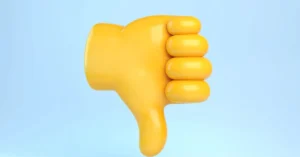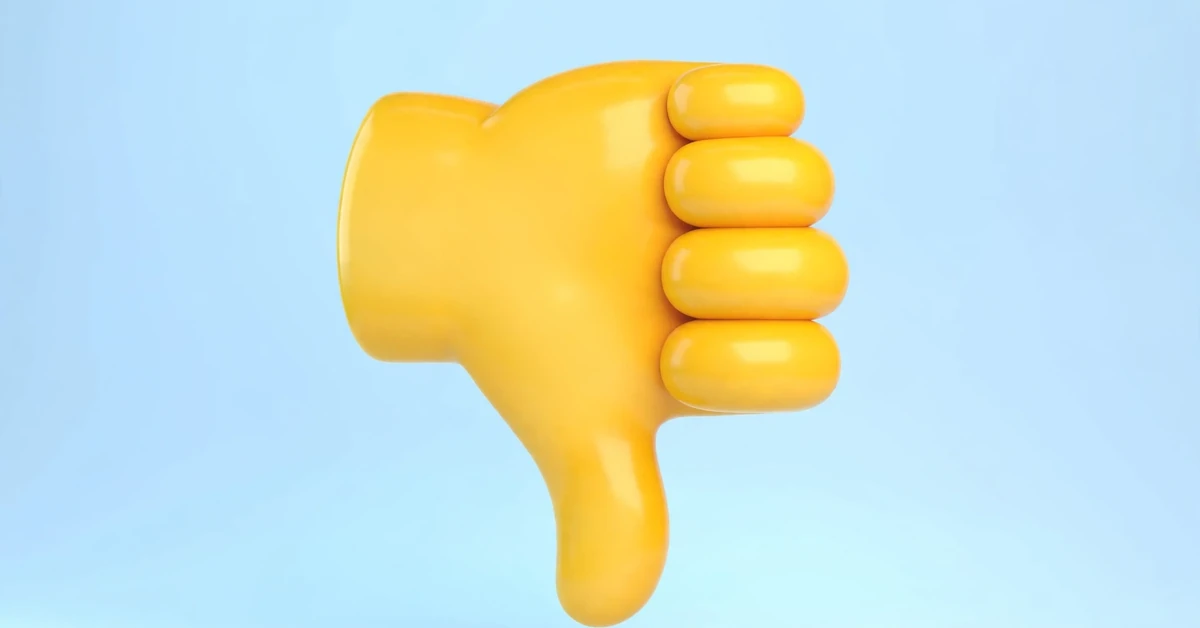
Everyone knows this gesture, even offline. The thumbs down emoji 👎 means no — dislike, disagreement, or a flat “not good.”
In chats it usually lands as a soft verdict. But it can still sting when it answers the wrong message, and knowing the difference matters.
What Does the Thumbs Down Emoji Mean?
A hand, thumb pointing down. The gesture has signaled disapproval for a very long time, and the emoji kept the meaning untouched.
People use 👎 for:
- A quick no. Voting against a plan, a place, a take.
- Dislike. The song, the update, the new design — not a fan.
- Bad news reactions. Answering a story about a delay or a price hike.
- One-emoji reviews. The whole opinion, in one tap.
It is the mirror of the thumbs up emoji — same hand, opposite vote. Where 👍 approves, 👎 closes the matter the other way.
Platforms built whole systems on it. Reaction buttons, downvotes, dislike counts — the thumbs down is the internet’s official “no.” Some sites even softened it over time because public 👎 piles felt harsh, which tells you something: even at internet scale, this small hand carries real weight.
👎 in Chats: A Soft “No”
Group chats run on small votes, and 👎 is built for them.
- “Pizza again tonight?” 👎 — not a speech, just a vote for something else.
- Reacting to a plan that doesn’t work for you.
- Rating a song or a clip a friend dropped in the chat.
In these spots, 👎 is softer than typing out “I don’t like this.” It keeps the decision moving without turning into a debate. The emoji disagrees with the idea — and importantly, not with the person.
Watch it work in real chats:
- “Where should we eat?” → 👎 on the sushi option. Nobody is insulted; the vote just failed.
- “Streaming night — horror or comedy?” → the horror poster gets a 👎, everyone laughs, comedy wins.
- “Bringing the speaker?” → 👎 means “leave it,” not “you’re annoying.”
Small, fast, friendly — that’s the whole job description.
Apps noticed. Polls, reactions, and quick-vote features across chat apps pair 👍 and 👎 as the default voting set — which trained everyone to treat the down thumb as a normal, low-drama “no.” That is why it feels so much lighter in chats than it looks on paper: your thumbs vote a dozen times a day now, most of it about lunch.
The softness has a limit, though. It’s soft about things and plans. Pointed at someone’s own effort, the temperature changes completely — more on that below.
👎 in Reviews and Votes
Scroll any comment section and you will find it. 👎 became the shorthand of public opinion:
- Movie takes: “The sequel 👎”
- Product opinions under unboxing posts
- “Rate my setup” threads, where 👎 is a full verdict
For a harder, more final kind of “wrong,” people reach for the red X emoji instead. 👎 says “I don’t like it”; ❌ says “incorrect.” The difference is taste versus fact.
Creators feel the weight of it, too. A pile of 👎 under a post is public in a way a typed dislike is not — which is why thoughtful commenters often add one line of reason next to it. YouTube even hid its public dislike counts once the numbers became a weapon, not a rating. The emoji survived in comments anyway — people still want the single-tap “no.”
Is 👎 Rude? Reading the Room
The honest answer: it depends entirely on what it answers.
Not rude:
- Polls and plan votes among friends
- Shared complaints about things — weather, traffic, a bad update
- Jokes where everyone is already roasting the same target
Can feel rude:
- As the only reply to someone’s work — their cooking, their song, their design. It feels like a boo with no reason attached.
- Sent by a boss or teacher with no explanation.
- Dropped into a serious conversation where someone shared real news.
- In a pile-on: one 👎 is a vote, but ten 👎 on one person’s post reads like a verdict on them, not the thing. Group disagreement drifts into ganging up fast online. If you join a crowd, add words — “not for me, here’s why” keeps it honest instead of cruel.
The fix is tiny: add three words. “Not for me 👎” votes against the plan. A bare 👎 can feel like it votes against the person.
Timing matters too. A 👎 five seconds after someone shares something reads as a reflex against the person. The same 👎 an hour later, inside a thread where everyone is rating, reads as part of the game. Speed plus silence is what makes it feel personal.
👎 vs 👇: Down Is Not Dislike
This mix-up flips meanings daily. 👇 — backhand index pointing down — does not dislike anything. It points: “look below.”
- “Link in bio 👇” — guidance, not an opinion
- “Full list 👇” — the content is under this line
- “This 👇” — pointing at the thing being reposted
Now swap in 👎 by accident, and “Details 👎” insults the details. Creators use 👇 constantly in captions, so the slip is common — and worth a two-second check before you hit send.
Same direction, opposite jobs: 👇 guides the eyes, 👎 casts a vote.
One practical footnote: skin tones and gender variants exist for 👎, like all hand emojis. The vote reads the same in every version. Most people leave the default yellow — in voting contexts, nobody is really looking at the hand; they are looking at the verdict.
FAQs
What does 👎 mean in a text?
A plain no: dislike, disagreement, or a low rating. In friendly chats it usually targets a plan or a thing, not the person. The softer the chat, the softer the emoji reads.
Is the thumbs down emoji rude?
To things and plans, no. As the only reply to someone’s personal effort or news, it can be — it gives a verdict with no warmth and no reason. Adding a short line fixes most of the coldness.
What does 👎 mean from a boss?
Usually a plain “no” on a proposal, an idea, or a draft. It is rarely personal, but it is also unexplained — a fair reply is to ask, in words, what would work better.
What is the difference between 👎 and 👇?
👎 is an opinion: dislike. 👇 is a pointer: look below. Using 👎 where you meant 👇 turns directions into an insult, so captions deserve a quick double-check.
When should I use words instead of 👎?
Whenever the thing being judged was made by the person you’re talking to. Their meal, their project, their news — those deserve reasons, not a bare verdict.
The short version: 👎 is a vote, not a review. Use it on things and plans freely. On people’s work, add words — or stay silent.

Hi, I’m Daniel Pierce, a writer at Symboliism.com who specializes in love symbols, relationship numbers, and their hidden meanings. I break down romantic signs, soulmate numbers, and emotional symbolism in a simple, relatable way. My goal is to help readers understand the deeper messages behind love, connection, and the symbols that guide our relationships.