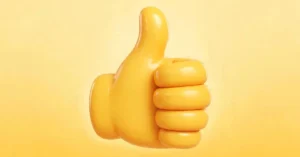
Ask two people what 👍 means and you may get two different answers. Officially, the thumbs up emoji means yes, OK, got it, agreed.
But send it completely alone, and many younger readers see something colder — like the chat just got closed on them. That split is what this article explains. (If you came for the jokes, our thumbs up meme guide covers the funny side; this page sticks to meaning.)
What Does the Thumbs Up Emoji Mean?
At its core, 👍 is approval in its simplest form:
- Yes. To a question, a plan, a suggestion.
- Got it. Your message landed; no reply needed beyond this.
- Agreed. I back this decision.
- On it. The task is accepted and moving.
It is also one of the main “reaction” emojis — the tap you give a message so the sender knows it was seen and accepted. Of all the hand emojis, it is the oldest signal and the most widely understood across ages, languages, and platforms.
Small nuance worth knowing: a reaction 👍 (tapped onto a message) reads softer than a reply 👍 (sent as its own message). The reaction feels like a nod from across the room. The reply feels like the whole answer. Much of the famous “cold thumb” problem lives in replies — which is why adding one word to a reply fixes it so completely.
So why does it start arguments? Because a symbol this simple carries tone — and people read tone very differently.
One more wrinkle: the gesture itself is not welcome everywhere. In a few places, a raised thumb is an insult rather than approval. The emoji mostly escaped that — on screens, 👍 means “good” almost worldwide — but it is one more reminder that even the simplest hand sign carries local rules in real life.
👍 at Work: Fine or Cold?
Work is where 👍 does most of its daily labor — and where it causes most of its trouble.
Where it works beautifully:
- Logistics. “Meeting moved to 3” → “👍” is fast, clear, and complete.
- Confirmations. Files received, tasks done, links checked.
- Group updates where a dozen people just need to signal “seen it.”
Big teams run on it. When twenty people answer one announcement with a thumb each, the manager gets twenty confirmations and zero new messages to read. That is the 👍 economy at its best: everyone is informed, nobody typed a sentence, and the chat stays quiet. In busy channels, a thumbs up is genuinely more polite than a flood of “okay!” replies.
Where it turns cold:
- As the only reply to a long, careful message. The sender wrote three paragraphs; “👍” can read as “noted, whatever.”
- From a manager. A boss’s bare 👍 carries weight — juniors read mood into it that may not exist.
- Attached to anything emotional: an apology, a worry, a request for support.
One small fix solves most of it: add a word. “Done 👍” and “Perfect, thanks 👍” keep the speed and lose the ice.
The Generational Split Over 👍
This is the famous part. For many older users, 👍 is simply a polite OK — the natural end to a conversation, nothing more.
Many younger users grew up texting differently: full sentences, expressive emojis, constant tone signals. In that world, a bare 👍 is the driest reply possible. It reads as annoyed, sarcastic, or dismissive — a digital “sure. whatever.”
Neither side is wrong. It is a dialect gap, like one generation’s friendly wave being another’s stiff nod.
The clash zone is predictable: family group chats, mixed-age work teams, anyone texting their parents. The practical rule is to match the other person’s style. If they send words, send words. If they live in 👍, your 👍 is fluent.
There is one more reading worth knowing: “conversation over.” To a younger reader, a bare 👍 after a long message doesn’t just mean “okay” — it means “we’re done here,” like a hand on the door. The sender meant nothing of the sort. That gap, between “noted” and “closed,” is where most thumb-related hurt lives.
👍 vs 🙏 vs ✅: Agreeing Three Ways
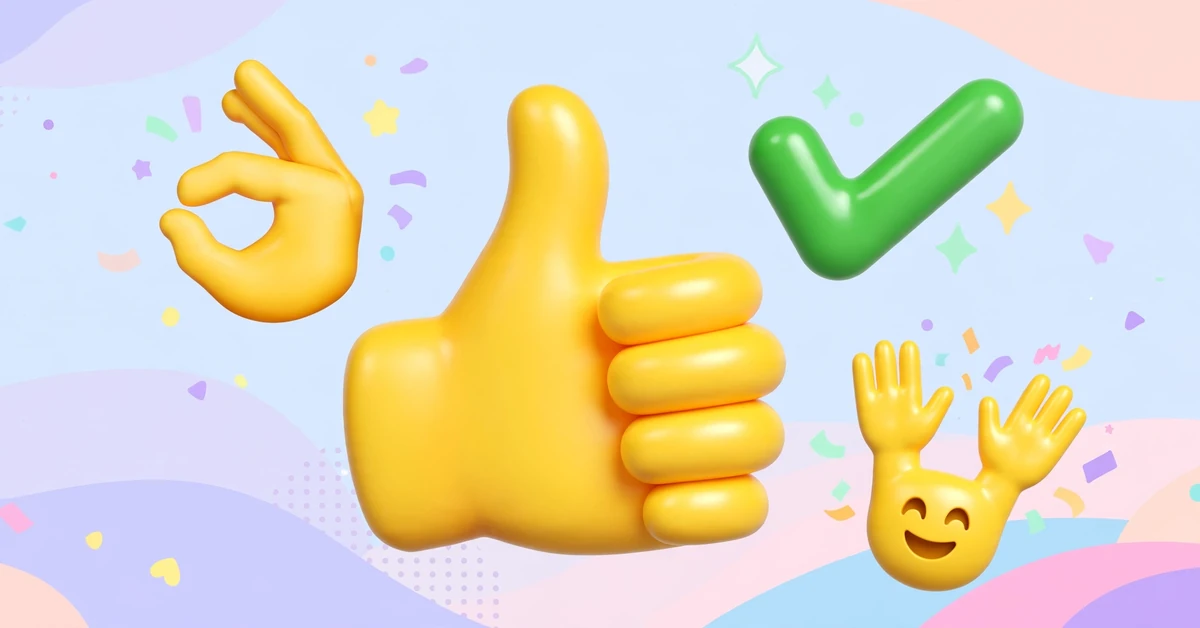
Three emojis get used for “yes”-adjacent jobs, and they are not interchangeable:
- 👍 Thumbs up — agreement. “Yes, OK, approved, I’m in.” It’s a vote.
- 🙏 Folded hands — thanks and please. The praying emoji says “thank you,” “please,” or “hoping so.” It’s gratitude, not a vote.
- ✅ Check mark — done and verified. “Finished, confirmed, official.” It reports a fact, not an opinion.
Mixing them changes the message. Answering “Can you send the file?” with 🙏 sounds like you’re asking a favor. Answering with ✅ before you’ve sent it is a small lie. 👍 is the safe middle: accepted, understood, agreed.
A few exchanges to lock it in:
- “Pick up milk?” → “👍” — perfect thumb territory.
- “Thank you so much!” → 🙏 — gratitude, not agreement.
- “Did it land?” → “✅ sent” — fact, not opinion.
Run your next yes through that filter and you’ll rarely mis-pick again.
When to Skip 👍 Entirely
Some messages deserve more than a thumb, no matter who sends it:
- Big personal news. Engagements, babies, new homes — a bare 👍 looks bored by the happiest day of someone’s year.
- Bad news and condolences. Here 👍 is not cold, it’s harmful. Words, always.
- Apologies. Replying 👍 to “I’m sorry” reads as a door slam.
- When someone is upset with you. The thumb becomes a shrug in disguise.
And note its mirror: the thumbs down emoji is blunter still. On anything personal, words beat both thumbs.
Two more common traps: replying 👍 to a joke (it can look like you didn’t get it) and approving your own announcement with 👍 in a group (it reads as grading your own homework). Small things — but tone is built from small things.
FAQs
Is 👍 passive-aggressive?
It can read that way, especially sent alone to younger readers or after long messages. To many others it is just a friendly OK. If the relationship matters, one extra word removes all doubt.
Why do young people read 👍 as rude?
Habit, not malice. They grew up where warm replies include words or expressive emojis, so the driest possible reply stands out. A bare 👍 feels like the sender stopped caring mid-chat.
Is 👍 okay at work?
Yes — for logistics and quick confirmations it’s the standard. For feedback, sensitive topics, or anything a person worked hard on, pair it with words. Managers should be extra careful; their 👍 is never read as small.
What is the difference between 👍 and ✅?
👍 is an opinion: yes, agreed. ✅ is a status: done, verified. Use 👍 to approve a plan and ✅ to report it finished.
What should I send instead of a bare 👍?
“Sounds good,” “On it 👍,” or “Perfect, thanks.” If the news is big, a warm emoji like 🎉 or ❤️ plus a real sentence will always beat a lone thumb.
The short version: 👍 still means yes — but the warmest yes has a word attached. Use the thumb for facts and logistics, and your words for people.

Hi, I’m Elena Brooks, a symbolism writer for Symboliism.com with a passion for spiritual growth numbers and their deeper meanings. I specialize in explaining awakening symbols, soul-path signs, and transformation numbers in a clear and inspiring way. My goal is to help readers understand the messages that guide their spiritual journey and personal evolution.