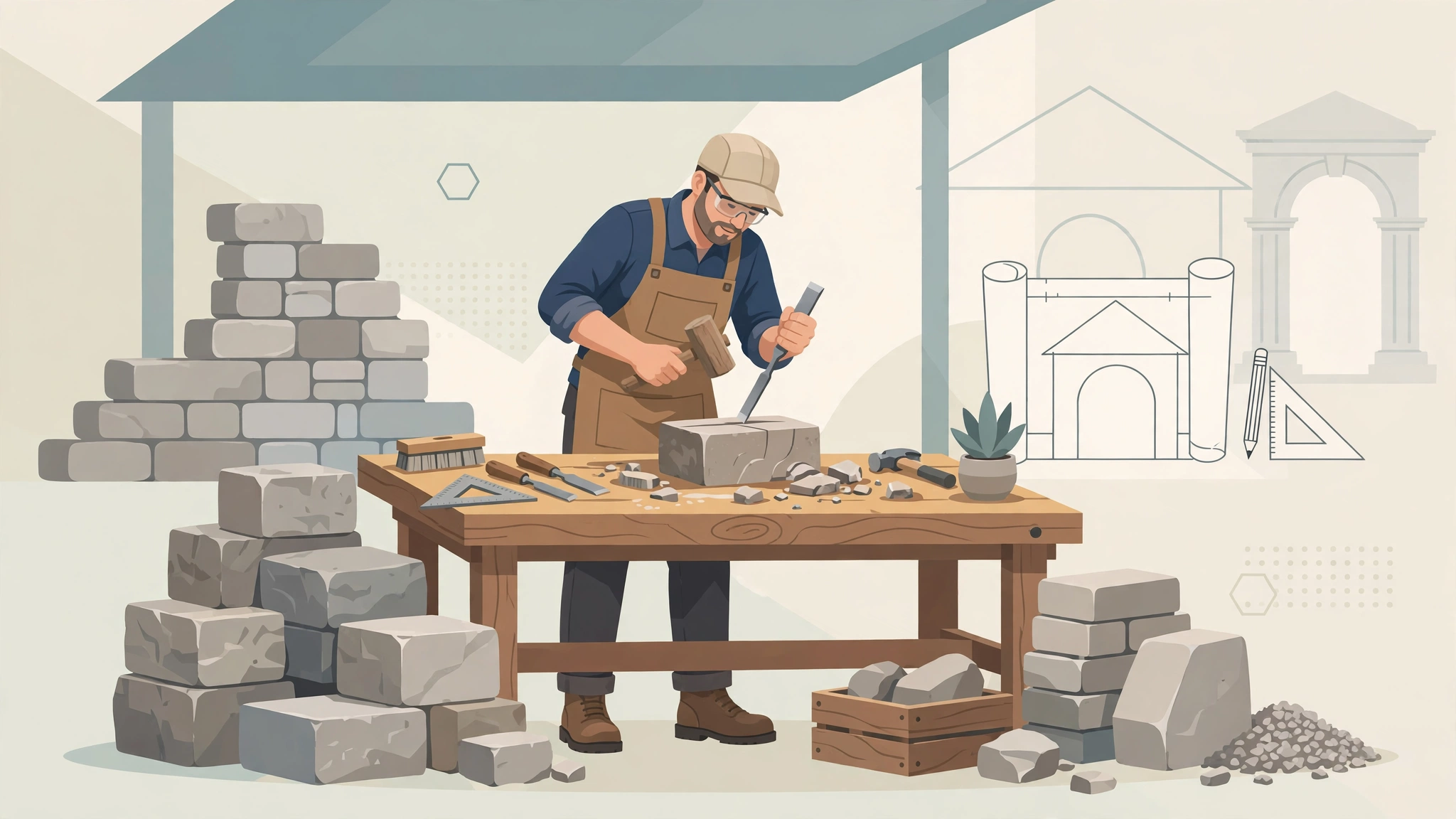
A mason wears two famous hats. Lowercase, a mason is the craftsperson who builds with stone, brick, and concrete blocks — the hands behind garden walls and great cathedrals alike. Capital M, a Mason is a member of the Freemasons, the centuries-old fraternity organised in local lodges. That is the quick answer, and it also explains the third thing you already know: Mason, the popular boys’ name, which simply means “stoneworker.” The key takeaway: a mason builds with stone and brick, a Mason (capital M) belongs to Freemasonry, and both grew from the same workshop.
What does mason mean?
One root word, three living senses:
| Sense | What it means | In one line |
|---|---|---|
| Mason (trade) | A skilled worker who builds with stone, brick, or concrete blocks and mortar | “The mason rebuilt the garden wall in two days.” |
| Mason (Freemason) | A member of Freemasonry, the fraternal society organised in lodges | “Her grandfather was a Mason for forty years.” |
| Mason (name) | A first name and surname taken from the trade | “They named the baby Mason.” |
Within the trade itself, two old job titles hide inside the word: a stonemason shapes and lays stone, while a bricklayer works in brick — though most modern masons happily do both, plus blockwork, paving, and repair. The tools tell the story: trowel, level, plumb line, and the patience to keep every course straight.
Where does mason come from?
English borrowed mason from the Old French maçon in the centuries after the Norman Conquest, when castle- and cathedral-building boomed. The trail behind French points to a Germanic root with the simple sense of “maker” — a close cousin of the English word make itself. In the Middle Ages, the finest stonecutters formed guilds and met in site huts also called lodges; their craft guarded real trade secrets about arches, vaults, and geometry. Over time, some lodges began admitting gentlemen who were not working stonemasons, and in 1717 four London lodges joined to form the first Grand Lodge — the date usually taken as the birth of organised Freemasonry. The “free” in Freemason is honestly debated: the popular explanation points to freestone, the soft, fine stone reserved for detailed carving, while others read it as masons “free” to travel and work from town to town.
How to use mason in sentences
Three natural examples, one for each hat the word wears:
“The mason repointed the brickwork on our chimney before the winter storms arrived.”
“He has been a Mason since his twenties and still helps run the lodge’s charity dinners.”
“They chose the name Mason to honour his great-grandfather, who had built half the village.”
Notice the spelling signal: the trade is lowercase (“a mason laid the stones”), while the fraternity member takes the capital (“a Mason attended the lodge meeting”). Writers use that single capital letter to do a great deal of quiet work.
Similar words to mason
- Bricklayer — the specialist in brick and block; many masons are bricklayers, but not every bricklayer works stone.
- Stonemason — the stone specialist: quarrying, cutting, carving, and setting stone.
- Freemason — the full, formal name for a member of the fraternity; “Mason” is its short form.
- Builder — the general word for construction workers of every trade; mason names one skilled branch.
- Craftsman / craftsperson — any master of a skilled hand trade; masons are the classic medieval example.
When to use mason — and notes on tone
Use mason when:
- You mean real construction work with stone, brick, or block (lowercase).
- You refer, factually and neutrally, to a member of a Masonic lodge (capital M).
- You discuss the name Mason or surnames born from trades.
Keep these notes in mind:
- Writing about Freemasonry calls for plain, factual language: it is a fraternity with lodge meetings, charitable work, and some ceremonies members keep private — not material for dark hints.
- A Mason jar is a different Mason entirely: the glass jar was named for John Landis Mason, who patented its screw-top design in 1858.
- In building talk, masonry is the mass noun for the work itself: “the masonry needs repair.”
FAQs about mason
What work does a mason actually do?
A mason builds and repairs structures from stone, brick, and concrete blocks, joining them with mortar: walls, chimneys, fireplaces, patios, and foundations — and restoring old stonework on churches and historic buildings.
Is a mason the same as a bricklayer?
They overlap heavily. A bricklayer specialises in brick and block, a stonemason in stone, and “mason” is the wider trade name that covers both — many workers train across all three.
What is a Freemason in simple words?
A Freemason is a member of Freemasonry, a fraternity that grew out of medieval stonemasons’ guilds. Today’s members meet in local lodges, use symbols inherited from the building trade — most famously the square and compasses — support charities, and keep parts of their ceremonies private to members.
Why is Mason sometimes written with a capital M?
Capital M marks the member of the fraternity (short for Freemason) or the personal name. Lowercase mason is only the building trade. The capital letter is the whole difference on the page.
Is Mason a popular name today?
Yes — as a surname it began with medieval stoneworkers, and as a first name it climbed into the top ranks for boys in English-speaking countries in the 2010s, where it has stayed. Parents like its solid, hardworking ring.
Final thoughts on mason
Few words travel so far on one pair of hands: from cathedral scaffolding to lodge rooms to birth certificates, mason keeps its honest meaning of skilled making. Learn the capital-letter rule and the word will always treat you fairly. A mason builds with stone and brick; a Mason belongs to the old fraternity that grew from those same builders.
Hi, I’m Oliver Grant, a symbols and numbers researcher at Symboliism.com. I specialize in decoding the hidden meanings behind spiritual signs, numerical patterns, and everyday symbols. I love turning complex symbolism into simple, clear explanations that help readers understand the messages guiding their life, intuition, and decisions.