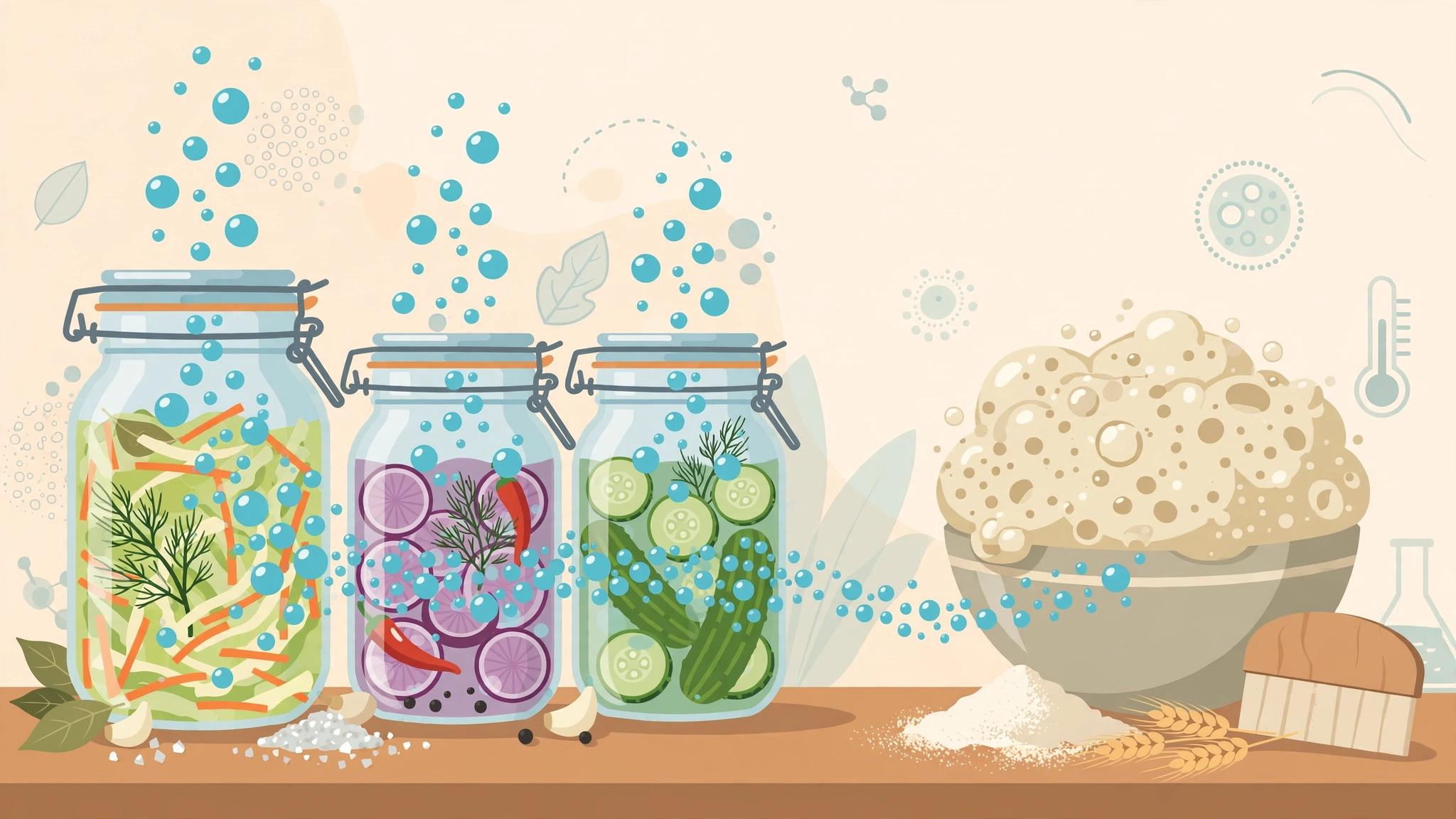
Fermentation is the quiet magic that happens when tiny living things — yeasts and friendly bacteria — eat the sugars in food and turn them into bubbles, gentle acids, or alcohol. That is the quick answer. No oven, no flame: the microbes do the cooking. This invisible workforce raises your bread, tangs your yogurt, sharpens your kimchi, and gives beer its sparkle.
Humans trusted fermentation for thousands of years before anyone knew microbes existed; we simply kept the jars that tasted good.
The key takeaway: fermentation means microbes transforming food, slowly and deliberately, into something tastier and longer-lasting.
What does fermentation mean?
In science words: fermentation is a biological process in which microorganisms break down sugars and starches without needing oxygen, releasing energy plus by-products. Those by-products are the whole story, and they come in three famous families:
| Kind of fermentation | The tiny workers | What they produce | Foods you know |
|---|---|---|---|
| Alcohol fermentation | Yeasts | Alcohol and carbon-dioxide gas | Beer, wine, and the bubbles that raise bread dough |
| Lactic acid fermentation | Lactic acid bacteria | Lactic acid, the gentle tang that also preserves | Yogurt, kimchi, sauerkraut, sourdough, brined pickles |
| Acetic fermentation | Acetic acid bacteria | Acetic acid — vinegar | Vinegar itself, and much of kombucha’s bite |
Nearly every traditional cuisine keeps a fermented treasure: Korean kimchi, German sauerkraut, Japanese miso, Indian idli batter, Ethiopian injera. The names change; the workforce does not.
Where does fermentation come from?
The word comes from the Latin fermentum, meaning leaven or yeast, rooted in fervere, “to boil” — because a fermenting vat bubbles and froths as if it were boiling, with no fire beneath it. The practice is far older than the word: pottery jars in China held a fermented drink of rice, honey and fruit some nine thousand years ago, and Egyptian bakers and brewers were masters of it five thousand years back.
Yet nobody knew why dough rose until the 1850s and 60s, when Louis Pasteur showed that living yeast and bacteria — not mere chemistry — do the fermenting. Later work found that enzymes inside the yeast do the actual sugar-splitting, but Pasteur’s insight stands: fermentation is microbes, alive and at dinner.
How to use fermentation in sentences
Three natural examples, from bakery to cellar:
“The dough needs two quiet hours: fermentation will do what no amount of kneading can.”
“Every autumn the family fills a clay pot, trusting fermentation to turn cabbage and chillies into kimchi.”
“The winemaker checks the fermentation twice a day, listening for the bubbles to slow.”
You will also meet the verb everywhere — dough ferments, grapes ferment, ideas are sometimes said to ferment — and the adjective fermented now proudly labels foods in every supermarket.
Similar words to fermentation
- Leavening — anything that puffs dough with gas; fermentation is the natural way, baking powder the shortcut.
- Brewing — fermentation aimed at beer (and, loosely, the making of tea or coffee, though no microbes are invited there).
- Culturing — growing friendly bacteria deliberately, as in cultured butter and yogurt; the microbes arrive as guests.
- Pickling — preserving in acid; careful, though: quick pickles are dunked in ready-made vinegar and never fermented, while brined pickles ferment for real.
- Spoiling — the uncontrolled cousin: microbes again, but the wrong crowd, arriving uninvited. Fermentation keeps that crowd out.
When fermentation is the right idea — and honest notes
Think fermentation when:
- You cook, bake, brew, or study food science — it is the correct technical word.
- You explain why traditional foods keep safely without fridges: acid and alcohol guard the gates.
- You read labels: “fermented” promises live microbial work, not just flavouring.
Keep these honest notes in mind:
- Fermented is not a magic word for health: many fermented foods carry live cultures that may support gut health, but the evidence is modest and varies by food — enjoy them as foods, not medicines.
- Alcoholic fermentation really makes alcohol: beer and wine are not for everyone, and even kombucha can carry traces.
- Home fermenting is safe when done properly — clean jars, right salt, trusted recipes; bubbling is expected, mould and foul smells are not.
FAQs about fermentation
Is fermented food just rotten food?
No — it is the opposite arrangement. Fermentation is controlled change by chosen microbes, guarded by salt, acid, or alcohol; rotting is uncontrolled change by whichever microbes arrive. One is a recipe, the other an accident.
Does all fermented food contain alcohol?
No. Lactic fermentation makes acid, not alcohol, so yogurt, kimchi, and sauerkraut contain effectively none. Bread starts with alcohol-producing yeast, but the oven burns the alcohol away; only beer and wine keep it.
Is yogurt really fermented?
Yes. Friendly bacteria are added to warm milk, where they ferment its sugar (lactose) into lactic acid. The acid thickens the milk and gives yogurt its clean tang — a textbook lactic fermentation.
What is the difference between fermenting and pickling?
A fermented pickle makes its own acid: vegetables sit in salty brine while bacteria produce lactic acid. A quick pickle borrows its acid ready-made from a bottle of vinegar. Both are preserved and tangy; only the first is fermented.
How long does fermentation take?
It depends on food and temperature: bread dough ferments in hours, kimchi and sauerkraut in days to weeks, and some cheeses, wines and soy sauces for months or years. Microbes set the schedule; cooks learn to read bubbles, smell and taste.
Final thoughts on fermentation
Fermentation fed humanity long before we could see a microbe, and it still works the night shift in bakeries, dairies and breweries everywhere. From a Latin word for a false boil came one of food’s truest ideas: choose the right tiny workers, feed them, and wait.
Fermentation means controlled change by microbes — and patience, measured in bubbles.
Hi, I’m Nathan Cole, a symbols researcher and writer for Symboliism.com. I specialize in decoding money symbols, career numbers, and prosperity meanings. I love turning complex spiritual and financial symbolism into clear, practical guides that help readers understand the signs influencing their success, goals, and growth.