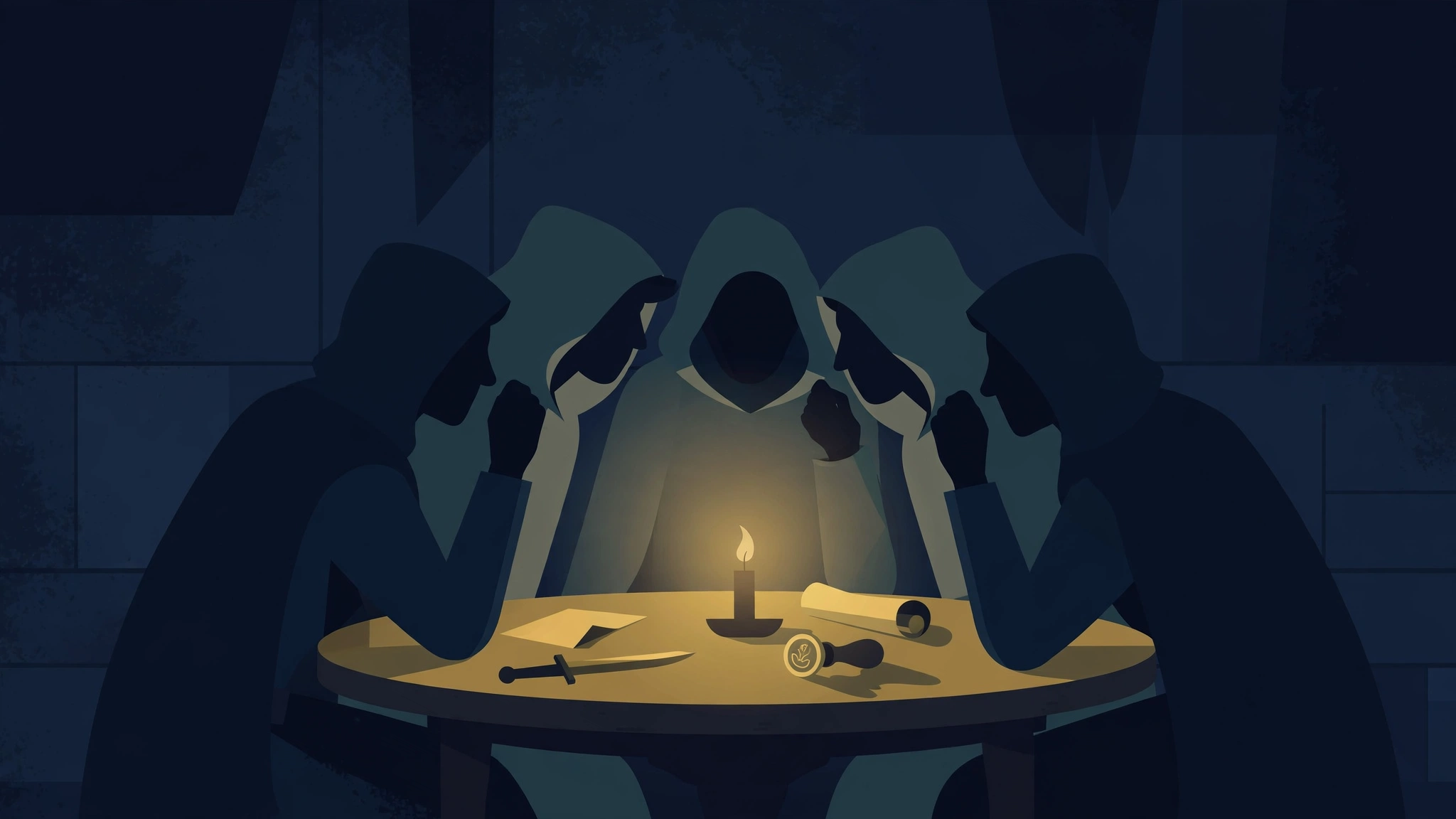
A cabal is a small, secret group of people — usually political — who meet and plot together to gain power or bring someone down. That is the quick answer. Think whispered meetings, coded plans, and decisions made in rooms the public never sees. You will meet this serious word in history books, spy stories, and sharp opinion columns, and it is never a compliment: if people call a group a cabal, they are accusing it of scheming in the dark. The key takeaway: a cabal is a secret plotting circle, and the word itself is an accusation.
What does cabal mean?
In plain words, a cabal is a tight group bound by a shared secret plan. Three ingredients make the word fit: the group is small, its dealings are hidden, and its goal involves power — keeping it, seizing it, or quietly removing someone who holds it. A club is not a cabal; a committee voting in public is not a cabal. Strip away the secrecy or the plotting and the word stops working.
| Sense | Meaning | Simple example |
|---|---|---|
| Cabal (noun) | A small secret group plotting, usually about political power | “A cabal of ministers met in private to plan the vote.” |
| To cabal (verb, rare) | To plot or scheme secretly together | “They caballed against the old duke.” (old-fashioned today) |
| The Cabal (history) | Nickname of Charles II’s inner ministry in the 1670s | “Historians still call those five ministers the Cabal.” |
Notice the tone. Journalists and rivals use cabal to make a group sound sinister, and no group calls itself one except as a joke. The word carries suspicion in its pocket wherever it goes.
Where does cabal come from?
The trail begins respectably. English took cabal from the French cabale, which came from cabala — the Latin form of Kabbalah, the Jewish tradition of mystical teaching. Because those teachings were guarded and passed to initiates, cabale in French drifted from “secret knowledge” toward “secret intrigue,” and by the 1600s it meant a plotting group. Now the famous story: in the 1670s, five of King Charles II’s closest ministers — Clifford, Arlington, Buckingham, Ashley, and Lauderdale — were noticed to have initials that spelled C-A-B-A-L. Londoners gleefully named them “the Cabal.” Honest historians add the correction: the word already existed before those five men; the initials were a lucky coincidence that fixed the word’s fame forever, not its true birth.
How to use cabal in sentences
Here are three natural examples, showing the word at work in history, accusation, and denial:
“The biography describes a cabal of courtiers plotting to remove the chancellor before winter.”
“The mayor angrily accused a cabal inside the council of leaking the budget documents.”
“There is no cabal running this chess club — we can barely agree on a day to meet.”
The first two examples show the word’s true habitat: palaces, parties, and power. The third shows its modern party trick — denying a cabal, with a smile, when a rumour gets too grand for a very ordinary group.
Similar words to cabal
- Clique — a small, exclusive social circle; snobbish, but plotters of nothing bigger than guest lists.
- Faction — an organised subgroup arguing inside a party or movement; often operates in the open.
- Junta — a group that has seized power, usually military; a cabal plots, a junta already rules.
- Conspiracy — the secret plan itself (also a crime in law); the cabal is the group doing the conspiring.
- Inner circle — the neutral phrase for the trusted few around a leader; add secrecy and plotting and it darkens into a cabal.
When to use cabal — and when to choose another word
Use cabal when:
- You write history, political analysis, or fiction about genuinely secret plotting.
- You quote or report someone else’s accusation: “critics called it a cabal.”
- You want the full shadowy tone on purpose, in opinion writing.
Choose a different word when:
- The group is ordinary and public — committee, team, or circle is honest; cabal accuses them of plotting.
- You have no evidence of secret plotting: making the charge in print without proof can defame real people.
- Children or colleagues are involved — the word’s conspiracy flavour lands harder than most speakers intend.
FAQs about cabal
What is a cabal in simple words?
A cabal is a small, secret group — usually political — that plots together to gain power or to bring someone down. Secrecy and scheming are always part of the meaning.
Is cabal a negative word?
Yes, thoroughly. It accuses a group of hiding its plans and hungering for power. Nobody introduces their own team as a cabal except in jest, which tells you everything about its tone.
What is the difference between a cabal and a clique?
A clique is about belonging — a closed social circle that keeps others out. A cabal is about plotting — a secret circle working toward power. Cliques exclude; cabals conspire.
Was cabal really an acronym of five ministers?
The initials were real: Clifford, Arlington, Buckingham, Ashley, and Lauderdale served Charles II together in the 1670s. But the word cabal is older than all five — the match was a coincidence Londoners enjoyed, not the word’s origin.
Does a cabal have to be political?
Politics is its home ground, but writers stretch it anywhere power hides: a “cabal of bankers,” a “cabal of critics.” The stretch works only because the political sense — secret plotting for control — comes with it.
Final thoughts on cabal
Cabal began in the language of sacred secrets, slipped into the corridors of French and English courts, and earned immortality from five ministers whose names happened to spell it. It still does one job superbly: naming the small, shadowy group that plans what the rest of us are not meant to hear. Use cabal when secrecy and plotting truly meet — and remember it always sounds like an accusation.

Hi, I’m Elena Brooks, a symbolism writer for Symboliism.com with a passion for spiritual growth numbers and their deeper meanings. I specialize in explaining awakening symbols, soul-path signs, and transformation numbers in a clear and inspiring way. My goal is to help readers understand the messages that guide their spiritual journey and personal evolution.