Thinking Emoji Meaning: Curious, Doubtful or Calling Bluff?
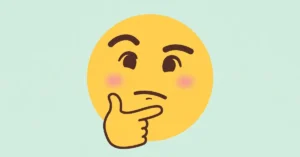
The thinking emoji means “hmm, let me think” — but the same chin-stroking face can sound curious, doubtful, or gently mocking depending on the sentence around it. The hand under the chin is the key detail. This is not daydreaming or confusion. It is active, skeptical consideration: someone is weighing what you just said.
That flexibility makes 🤔 one of the most context-dependent emojis. Sent wrong, it reads as smart and thoughtful. Sent slightly off, it reads as “I don’t believe you.” This guide teaches you to read it — and to send it — with the tone intact.
What Does the Thinking Emoji Mean?
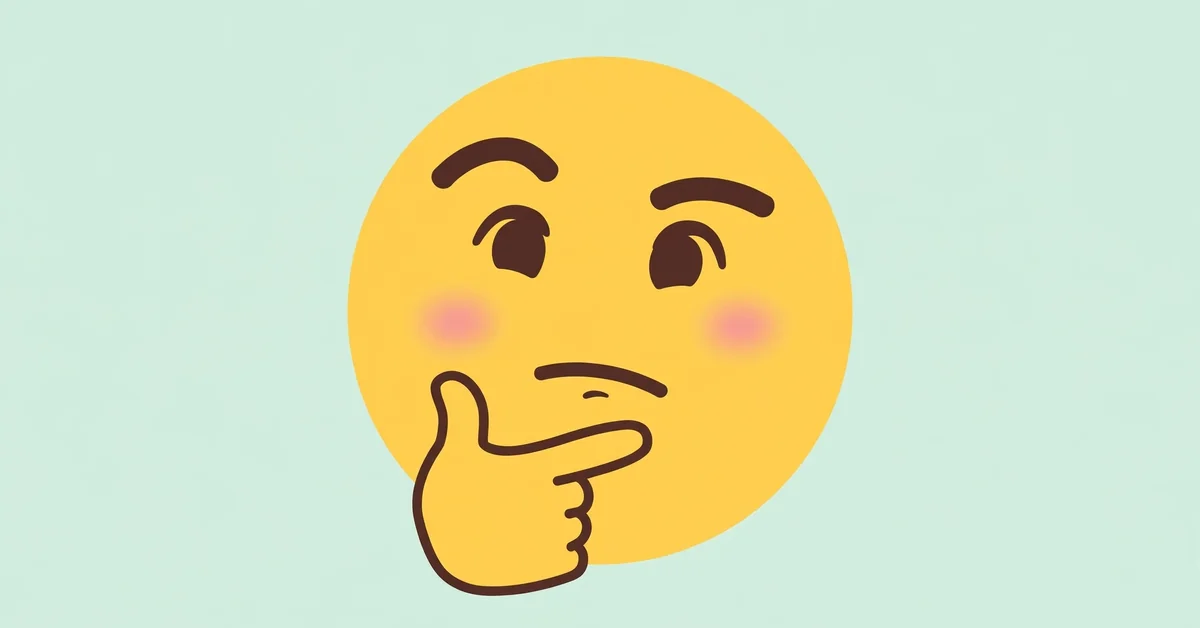
🤔 shows a yellow face with a raised eyebrow, one eye glancing upward, and a hand stroking the chin — the universal body language of pondering.
Its core meaning splits into three readings:
- Genuine thought. “Good question, let me think 🤔.” The sender is actually considering something. Neutral and honest.
- Polite doubt. “Really? 🤔” The chin stroke becomes a question mark worn on a face: I hear you, but I am not convinced.
- Playful challenge. “Are you suuuure about that 🤔” among friends. The emoji flags that the doubt is a joke, not an attack.
The mouth is the tell. On most platforms the face’s mouth is neutral or slightly pursed — not a smile, not a frown. That neutrality is what lets the same face serve all three jobs. A grinning version would kill the doubt reading; a frowning version would kill the playful one.
In practice, readers default to the middle: mild skepticism with soft edges. When someone texts back a lone 🤔 to your big claim, assume they are intrigued-but-unconvinced until the next message clarifies.
🤔 as a Question: “Are You Sure?”
The most common use of 🤔 is the polite challenge. It lets the sender question you without sounding rude.
- “You finished the whole report already? 🤔” — impressed but suspicious. The sender is half-joking that you must have superpowers.
- “That shop is closed on Mondays, just saying 🤔” — offering information with a raised eyebrow, like “double-check this.”
- “Hmm, wasn’t it 3 pm? 🤔” — disagreeing gently about a fact. The emoji does the job a direct correction would make awkward.
The trick is the softness. A bare “Are you sure?” in text reads harsh. With 🤔, the same words become a friendly nudge. The emoji takes the edge off the doubt — which is why people instinctively reach for it whenever they question someone they like.
That softening power has limits. Three 🤔🤔🤔 reads less like gentle curiosity and more like pressure: answer me, I am waiting. One emoji questions. Three interrogate.
🤔 as a Joke: Meme and Roast Uses
Friend groups weaponize 🤔 with love. The meme pattern goes like this: someone states something obvious or self-congratulatory, and a friend replies with 🤔 as if giving it serious philosophical review.
- “I’m basically a chef now” → “🤔” — the joke is the gap between the claim and reality.
- “That plan definitely works” → “are you SURE 🤔” — mock suspicion at a shaky plan.
- Posting an old photo with “good hair day” → friends reply 🤔 — loving roast territory.
The roast works because 🤔 is never mean on its own. Its default tone is thoughtful, so the joke reads as “I am examining this claim very seriously” — and the over-seriousness is the humor.
It also thrives in quote-posting, where someone shares a questionable take and the comments fill with nothing but 🤔. The emoji becomes a vote: this needs scrutiny.
When 🤔 Sounds Rude
The line between curious and rude is thin. Watch for these:
- After someone’s effort. Replying 🤔 to “I worked on this for weeks” lands as dismissal — it questions something that deserved support.
- To bad news. “My dad’s in hospital 🤔” would be awful, though it rarely happens by accident. Any face with irony under a serious post reads wrong.
- With power behind it. From a boss to an employee (“Finished? 🤔”), the emoji reads as mistrust — the softening that works between equals fails across hierarchy.
- Stacked and cold. “ok 🤔🤔🤔” is not three times thoughtful. It is a demand for explanation.
The pattern: 🤔 is safe with equals and jokes, risky with power gaps and serious moments. If someone just shared something vulnerable, choose a warm emoji or actual words instead.
The skeptical edge is also why 🤔 pairs with the raised eyebrow in our eyebrow raised emoji guide — together they are the full doubt toolkit, so use them apart when one is enough.
Pairing 🤔 With Words So It Lands Right
A few words next to 🤔 are worth a paragraph. The pairings that work:
- “Good point, let me think 🤔” — shows real consideration. Safe in any chat.
- “Interesting 🤔” — curious and open. The classic soft-doubt opening.
- “Hmm 🤔 you might be right” — concedes ground graciously.
- “Oh really? 🤔” — playful suspicion, only among friends.
- “Thinking about Thursday 🤔” — the literal use: actually deciding something.
And the pairings to avoid: “whatever 🤔” (cold), “fine 🤔” (passive), “okay then 🤔” (dismissive). Words that already sound short become colder next to a skeptical face.
One more habit worth copying: when you are genuinely unsure about a fact, send the emoji with your best guess — “I think it was March? 🤔” The emoji turns a potential mistake into an invitation to correct you, and people love correcting politely.
And when the doubt is about you rather than them, 🤔 becomes a journaling tool: “should I take the new role 🤔” texted to a friend is really asking “help me think this through.” The chin-stroking face invites the other person to join your thought process instead of just delivering a verdict — which is why it appears so often in decision chats, purchase questions (“this jacket? 🤔”), and plan debates.
Thinking Emoji FAQs
What does 🤔 mean in texting?
It means the sender is considering what you said — with curiosity, mild doubt, or playful suspicion. The sentence around it picks which one.
Is 🤔 rude?
Not by itself. It becomes rude when aimed at someone’s effort, bad news, or from a position of authority. Between equals and in jokes, it is perfectly friendly.
What is the difference between 🤔 and 🧐?
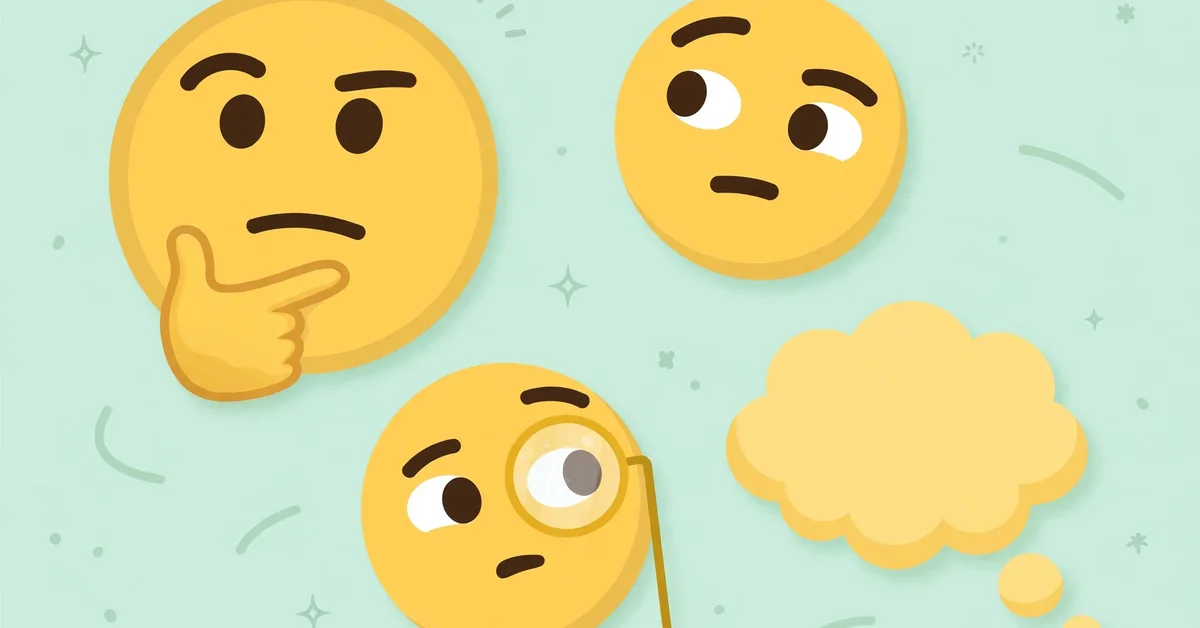
🤔 is casual and social — the everyday ponderer. 🧐 (face with monocle) is fancier and more formal: deep study, examination, “let me look closely.” 🧐 skews older and bookish; 🤔 skews meme-friendly.
What does 🤔 mean from a guy?
Most often playful skepticism or genuine consideration: “interesting, let me think.” In flirty chats it can be the teasing “are you sure?” — read the sentence, not the gender.
How do I use 🤔 without sounding condescending?
Keep it to equals and jokes, pair it with kind words (“interesting!”), and never send it to bad news or someone’s hard work. One emoji questions; three interrogate.
The Bottom Line
🤔 is a tone chameleon: thoughtful, doubtful, or teasing depending on company. Read the words first, then the face — and when you send it, make sure the sentence leaves room for the kind reading.

Hi, I’m Lena Foster, a symbolism expert and content writer for Symboliism.com. I specialize in explaining the meanings behind symbols, numbers, and signs in a simple, engaging way. I love turning complex spiritual and cultural symbolism into clear, easy-to-read guides that help readers understand the messages around them.