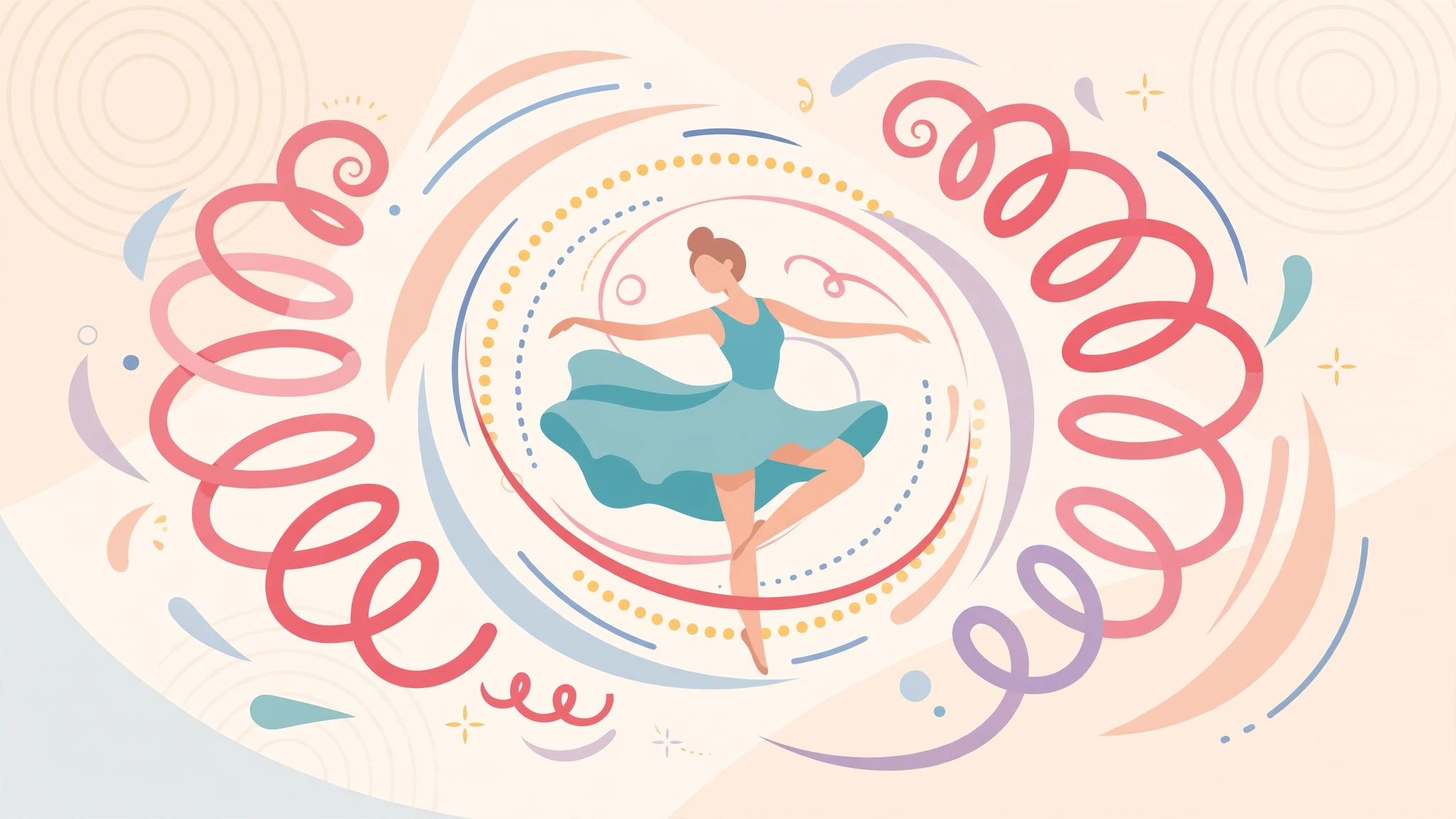
Gyrate means to move in a circle or a spiral — to spin or rotate with a smooth, swinging motion. That is the quick answer. Disco dancers gyrated under mirror balls, a washing machine gyrates through its spin cycle, and financial pages report that anxious markets “gyrate” up and down.
The picture is always the same: something circling round a centre point, over and over, with rhythm. It also carries a wink: used of dancers, the word can suggest hip-swinging movement, so context decides whether it sounds scientific or playful.
The key takeaway: gyrate means spinning in circles with a swing — machines do it neutrally, dancers do it with style.
What does gyrate mean?
In simple words, to gyrate is to revolve in a circular or spiral path. Unlike plain rotate, which suggests a steady mechanical turn around an axis, gyrate adds rolling and rhythm — the motion swings, loops, and comes back around. The noun form is gyration, and you will meet both in science, music, and the business pages:
| Where you meet it | What is gyrating | The flavour |
|---|---|---|
| Dance and music | Hips and bodies circling to a beat | Playful — and sometimes deliberately suggestive |
| Machines | Drums, rotors, and parts spinning in cycles | Neutral and technical |
| Money news | Prices and markets swinging up and down | Figurative: wild, repeated ups and downs |
| Nature and science | Air, water, and rings of current turning | Measured and descriptive |
One verb, four stages — the circling never changes; only the costume does.
Where does gyrate come from?
Gyrate comes from the Latin verb gyrare, “to turn in a circle,” built on gyrus, “a circle or ring,” which Latin had borrowed from the Greek gyros. The same round root gives us the gyroscope, the spinning instrument that holds its balance, and — a favourite fact — the gyro sandwich, named because its meat turns slowly on a vertical spit. The word’s history is well documented through Greek and Latin into modern English; no real mystery hides in it, just a very old picture of something going round.
How to use gyrate in sentences
Here are three natural examples, one for each of the word’s favorite stages:
“The dancers gyrated to the drumbeat under the coloured lights.”
“The old washing machine gyrated so hard in its spin cycle that it shuffled across the laundry floor.”
“Share prices gyrated all week while investors waited for the bank’s announcement.”
In the first sentence the motion belongs to bodies, in the second to a machine, and in the third the market only acts like a spinning thing — that figurative leap is standard in business writing.
Similar words to gyrate
- Rotate — the neutral, technical word for turning around an axis; no swing implied.
- Spin — the everyday word for fast turning; simpler and brighter than gyrate.
- Twirl — a light, playful spin, usually of a person or a small object.
- Revolve — to travel around an outside centre, like a planet around the sun.
- Whirl — to spin very fast, with a hint of dizziness and blur.
When to use gyrate — and when to pick a safer word
Use gyrate when:
- You describe machines cycling, wobbling, or spinning in loops.
- You write about dance in a knowing, adult context where energy and hips are the point.
- You report markets or prices swinging repeatedly — “gyrations” is business-page standard.
Choose a different word when:
- You describe children, students, or colleagues dancing — gyrate can sound suggestive about people, so twirled or spun stays safe and warm.
- You write a formal report or technical manual — rotate or oscillate sounds professional and exact.
- The moment is solemn. Gyrate is a lively word; it would strike the wrong note in serious or sad settings.
FAQs about gyrate
What does gyrate mean in simple words?
To gyrate is to spin or move round in circles with a swinging, rhythmic motion — like a dancer’s hips, a washing-machine drum, or prices leaping up and down.
What is the difference between gyrate and rotate?
Rotate is plain, steady turning around an axis — the engineer’s word. Gyrate adds roll and rhythm: the circling swings or wobbles, and when people do it, it usually happens on a dance floor.
Is gyrate a rude or suggestive word?
The word itself is innocent, but about dancers it often hints at hip movement, which can sound suggestive. In family, school, or office writing, “spun,” “twirled,” or “danced” keeps the tone safely neutral.
What does “market gyrations” mean?
It pictures prices spinning like a dancer: sharp rises and falls, again and again, with no settled direction. Journalists use “gyrations” when numbers swing wildly in a short time.
How do you pronounce gyrate?
Say JY-rayt, with the stress on the first syllable: JY as in “jive,” then “rate.” The noun, gyration, is jy-RAY-shun.
Final thoughts on gyrate
One more place this circling family shows up: the great ocean gyres, the slow-turning systems of currents that circle entire seas. From a wobbly ceiling fan to ocean-wide gyres and the humble gyro turning on its spit, the root picture never changes — round and round, with rhythm. That is why one small Greek word can dress up a dancer, a drum, and a market without ever feeling out of place.
Gyrate is the circling word with rhythm in its hips — as true of a straining washing machine as of a disco floor or a nervous stock market. Keep the picture of a swing inside the spin, and mind the audience when the subject is people.
Gyrate means to spin in circles with a swing: neutral for machines, playful for prices, and always a little knowing for dancers.
Hi, I’m Nathan Cole, a symbols researcher and writer for Symboliism.com. I specialize in decoding money symbols, career numbers, and prosperity meanings. I love turning complex spiritual and financial symbolism into clear, practical guides that help readers understand the signs influencing their success, goals, and growth.