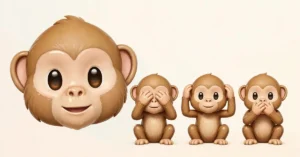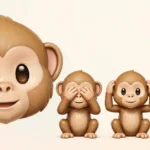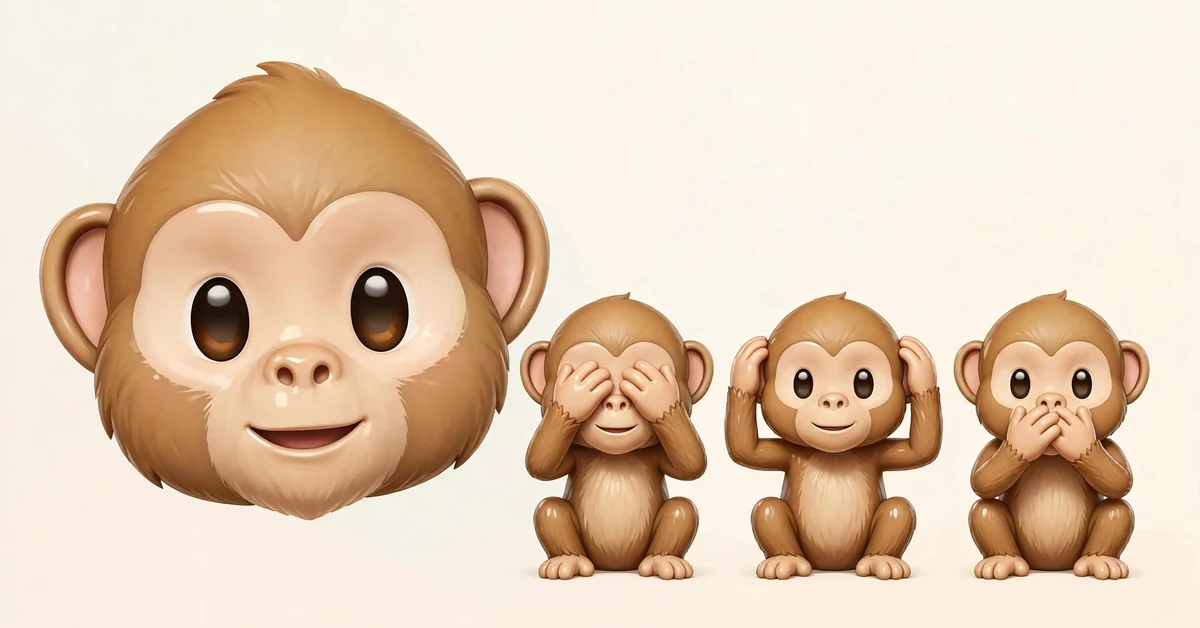
Say “monkey emoji” and four faces could come to mind. There is the plain monkey face 🐵, and the famous three — 🙈 🙉 🙊 — who cover their eyes, ears, and mouth. Each one carries its own message, and the covering-eyes monkey is the star of everyday chats.
This guide sorts the whole troop: where the wise three come from, why 🙈 became the “oops” emoji of the internet, and where the plain monkey still fits.
What Does the Monkey Emoji Mean?
The monkey family splits into two groups. First, the direct ones: 🐵 is the monkey face, and 🐒 is the full monkey. They mean monkeys — zoos, jungles, kids who will not sit still. Calling a playful child “my little monkey 🐵” is a use as old as phones with cameras.
Second, the symbol ones: 🙈 🙉 🙊 are not really about animals at all. They are the three wise monkeys, a picture proverb hundreds of years old. Each one blocks a sense — eyes, ears, or mouth — and each one has grown a chat meaning of its own.
That split explains the confusion in searches. People hunting “the monkey emoji” usually want the shy one with its hands over its eyes, not the zoo animal. Know which group you need, and you will always pick the right face.
One more real-monkey use: the Monkey is one of the twelve animals of the Chinese zodiac. In a Year of the Monkey, birthday and New Year posts for people born under it get flooded with 🐒. If a friend was born in a Monkey year, the emoji in your greeting is a personal touch they will notice.
The Three Wise Monkeys: 🙈 🙉 🙊
The three wise monkeys come from Japan, where their names are Mizaru, Kikazaru, and Iwazaru. A famous carving of them sits at the Toshogu shrine in Nikko. Their lesson is a proverb: see no evil, hear no evil, speak no evil.
In plain words, the proverb is advice about keeping your mind clean. Do not stare at bad things. Do not soak up gossip. Do not pass harm on with your own mouth. It is an old, kind rule for a good life.
The emojis kept the poses and softened the lesson. In chats they read less like morals and more like feelings — shy, deaf by choice, and zipped lips. But the shapes still carry a whiff of the old wisdom, which is why the three feel deeper than most animal emojis.
They also travel in a row. 🙈🙉🙊 together in a bio or a caption means “no drama, no gossip, not my circus” — a whole life motto in three small monkeys.
Each one also works solo with its own everyday job. 🙉 covers the ears for “I cannot hear you” jokes — a friend drops wild gossip in the group and you answer 🙉 to say “lalala, not listening.” 🙊 covers the mouth for secrets and slips: “I know something you don’t 🙊” or “pretend I did not say that.” Together they form a tiny toolkit for dodging trouble in chat.
🙈 “Oops”: The Everyday Sense
Here is the monkey that runs the internet. 🙈 — hands over the eyes — is the “oops” face of modern chat. Sent the text to the wrong person? 🙈. Told the joke out loud in a quiet room? 🙈.
It stands for cute embarrassment. When you use 🙈, you are saying “I cannot look” at your own small mistake, and you are laughing while you say it. That mix of shy and silly is why it beats the plain monkey in daily use.
It also works for shy compliments and flirty moments. “You look great today 🙈” hides the blush behind the hands. And it softens confessions: “I ate the last slice 🙈” asks for mercy with a grin.
Notice what it is not. 🙈 is light shame, the fun kind. For true regret or a real apology, words do the job. A monkey face on a serious sorry can look like you are not sorry at all.
Monkey in Bios and Kids’ Posts
The plain monkeys live happily in bios. 🐵 and 🐒 mark animal lovers, zoo staff, and parents who post about their wild little ones. Wildlife pages lean on 🐒 for jungle and rescue content.
Kids’ posts are full of them. Birthday shoots with jungle themes, first zoo trips, and “our little monkey is two” posts all carry 🐵. It is one of the safest, sweetest emojis a parent can use.
Animal chats reach for fellow creatures too. The goat emoji carries champion energy into pet and animal posts the same way, though for very different bragging rights.
In usernames, a monkey often claims playful energy: the class clown, the gym rat, the friend who is always mid-lark. It is a light badge. If your brand is calm or formal, a monkey will undersell you — pick a tamer symbol.
Sports and school teams claim it too. A monkey mascot stands for speed, mischief, and never sitting still — traits teams love to show off. Team chats wear 🐵 in win posts and practice updates, and rival fans borrow it for a bit of cheeky banter after a match.
Monkey Combos
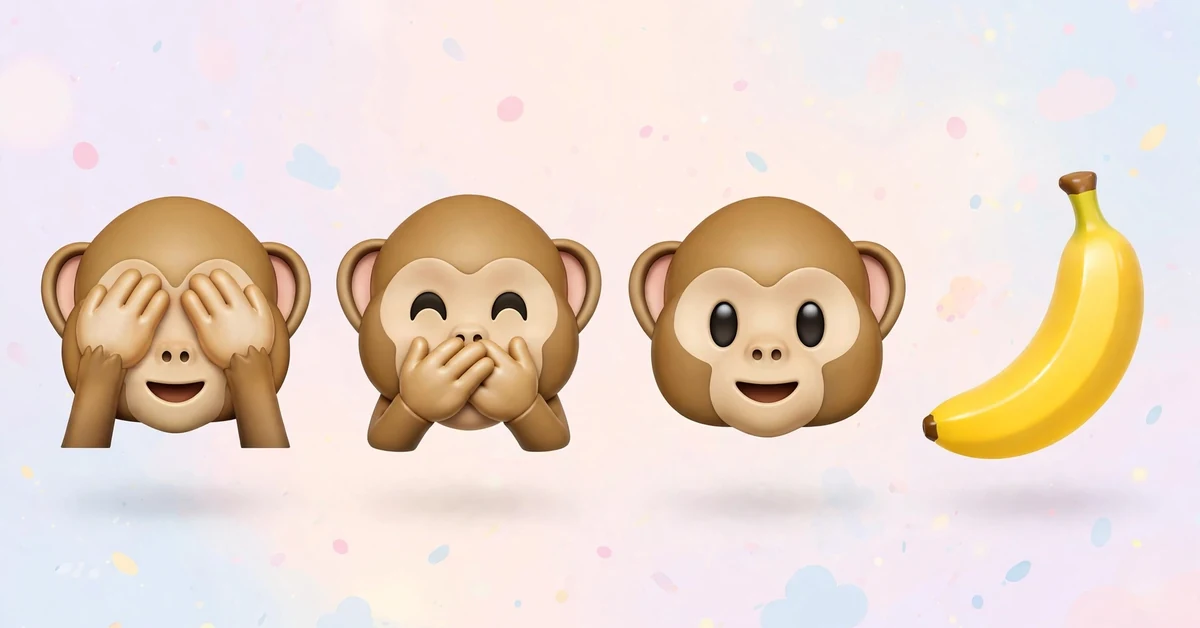
A few monkey rows show up again and again.
🙈 + 🙊 is the “oops, and I will say no more” double. A slip, then sealed lips.
🐵 + 🍌 is the cartoon classic. Banana plus monkey reads as pure play, great for kids’ posts and snack jokes.
🙈 + 🙉 + 🙊, the full wise row, works in bios, drama exits, and “staying out of it” posts.
🙊 + 🤐-style posts use the zipped mouth idea twice over — secret kept. For pure secret-keeping, 🙊 alone often says it cleaner.
🐒 + 🌴 + 🥥 is the jungle set. Travel posts from warm places love it.
Keep combos playful. The monkey family is built for fun, and long serious rows fight the spirit of the troop.
One small warning: in some languages and offices, long emoji rows in a work message read as noise. The monkeys play best with friends, family, and fun feeds. In formal threads, even 🙈 can look too light — there, words do the joking better than faces do.
FAQs
What does 🙈 mean in a text?
It means “oops” — cute embarrassment. People send it after small mistakes, shy compliments, or moments when they joke that they cannot bear to look.
What do the three monkey emojis stand for?
They are the three wise monkeys from a Japanese proverb: see no evil 🙈, hear no evil 🙉, speak no evil 🙊.
What is the difference between 🐵 and 🐒?
🐵 is just the monkey’s face. 🐒 is the whole monkey with a tail. The face suits reactions; the full monkey suits animals and jungle posts.
What does 🙊 mean?
It is the speak-no-evil monkey, and in chats it means sealed lips — a secret kept, or “I have said too much.”
Can I use 🙈 in an apology?
Only for tiny, funny slips. For a real apology, the monkey looks too light. Use plain, honest words instead.
Conclusion
The monkey emoji is really two families sharing one name. 🐵 and 🐒 are for animals and play; 🙈 🙉 🙊 carry the old wise-monkey lesson, with 🙈 ruling chats as the king of “oops.” Pick the right monkey, and your small slip or big joke lands just right.

Hi, I’m Nathan Cole, a symbols researcher and writer for Symboliism.com. I specialize in decoding money symbols, career numbers, and prosperity meanings. I love turning complex spiritual and financial symbolism into clear, practical guides that help readers understand the signs influencing their success, goals, and growth.