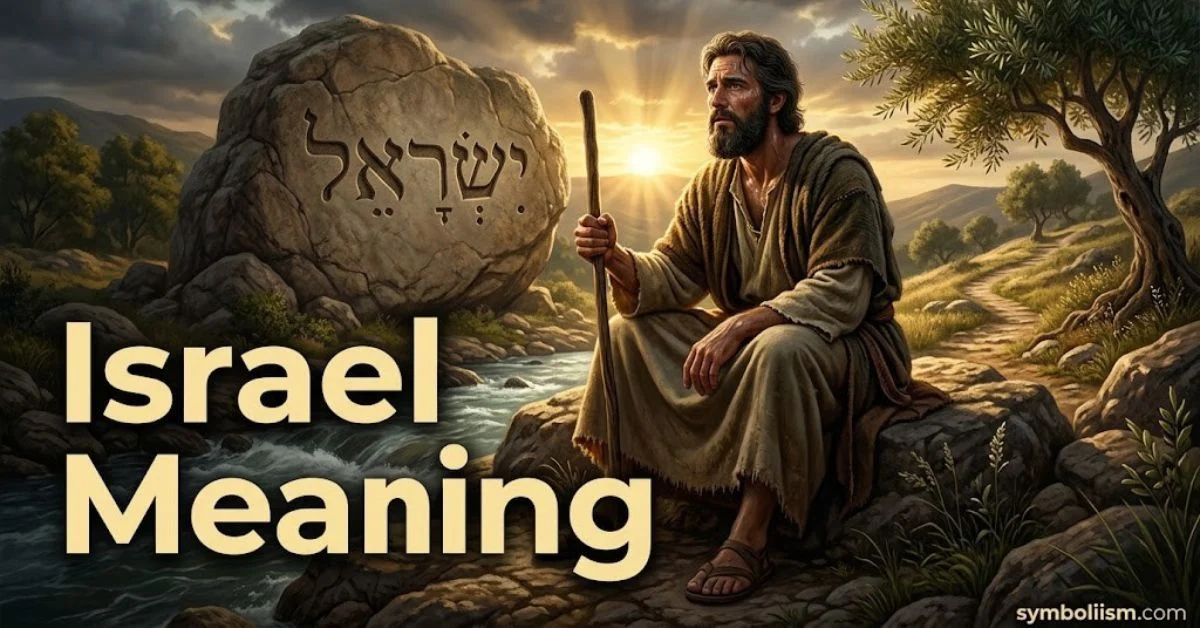
The Hebrew name Israel (יִשְׂרָאֵל, Yisrael) is commonly understood to mean one who struggles with God, God contends, or prince with God.
According to the Hebrew Bible, Jacob received the name Israel after a night of wrestling with a divine being. His descendants later became known as the Children of Israel.
The meaning of Israel has fascinated scholars, believers, and curious readers for centuries. It appears in Jewish tradition, Christianity, and Islam. It also carries linguistic significance that stretches across Hebrew, Greek, Arabic, Aramaic, and Latin sources.
This guide explores the Hebrew roots of the name, the biblical story behind it, and the spiritual lessons many people draw from it today.
Rather than repeating theories without context, we’ll look at the meaning of Israel through language, Scripture, and history to understand why this ancient name still resonates with millions of people around the world.
What Does Israel Mean in Hebrew?
At its core, Israel comes from the Hebrew name:
Yisrael (יִשְׂרָאֵל)
Hebrew scholars have long connected the name to two key elements:
- Sarah (שָׂרָה) : a root associated with striving, contending, or persevering.
- El (אֵל) : one of the Hebrew words for God.
Because ancient Hebrew names often carry layered meanings, several translations have emerged over time.
The most common interpretations include:
- One who struggles with God
- God contends
- He who perseveres with God
- Prince with God
While scholars may debate the exact nuance, they generally agree on the central idea: the name reflects persistence in relationship with God.
This theme becomes even clearer when we look at the biblical story behind it.
The Story Behind the Name Israel
Before he was called Israel, he was known as Jacob.
Jacob’s life in the Hebrew Bible was marked by conflict, mistakes, family tensions, and difficult choices. Yet one event changed everything.
On the night before meeting his estranged brother Esau, Jacob found himself wrestling with a mysterious figure until daybreak.
After the struggle, he was given a new name.
Your name shall no longer be Jacob, but Israel, because you have struggled with God and with men and have prevailed.
For many readers, this moment represents one of the most powerful transformations in Scripture.
Jacob entered the night carrying fear and uncertainty.
He emerged with a new identity.
Why Was Jacob Called Israel?
One of the most searched questions is:
Why did Jacob become Israel?
The name change marked more than a symbolic gesture.
In biblical tradition, names often reflected character, purpose, or destiny.
Jacob’s new name recognized his perseverance.
He did not walk away from the struggle unchanged. Instead, the experience shaped him into the person he was called to become.
Many faith communities see this story as a reminder that life’s hardest moments can refine character rather than destroy it.
What Does Israel Mean in the Bible?
The meaning of Israel shifts slightly depending on the biblical context.
Throughout Scripture, Israel can refer to four related ideas.
Jacob Himself
At first, Israel refers to the man formerly known as Jacob.
The Children of Israel
The term later describes Jacob’s descendants.
The Twelve Tribes
Jacob’s twelve sons became the ancestors of the Twelve Tribes of Israel, each with its own role and history.
A Covenant People
Israel also came to represent a people bound together through covenant, shared identity, and worship.
Understanding these layers helps readers interpret biblical passages more accurately.
The same word may describe an individual, a family line, a nation, or a spiritual community depending on the setting.
Does Israel Mean Wrestles With God?
The short answer is yes.
Many teachers summarize Israel’s meaning as:
He who wrestles with God.
This interpretation comes directly from Jacob’s encounter before receiving his new name.
However, Hebrew scholars note that ancient names often resist one-word translations. The grammar allows for several related meanings.
These include:
- One who struggles with God
- God strives
- God contends
- Prince with God
Rather than contradicting each other, these interpretations highlight different aspects of the same idea.
Faith is not always passive.
Sometimes it involves questions, perseverance, surrender, and growth through struggle.
Spiritual Meaning of Israel
For many readers, the spiritual meaning of Israel matters just as much as the linguistic definition.
The story speaks to universal human experiences.
It reminds people that:
- Growth often follows hardship.
- Faith can deepen during uncertainty.
- Identity is not fixed by past failures.
- Persistence shapes character.
- Struggle does not mean abandonment.
Jacob did not become Israel because life became easy.
He became Israel because he endured.
That message continues to resonate with people navigating their own seasons of doubt, grief, transition, or change.
Jacob to Israel: A Story of Transformation
The transition from Jacob to Israel represents one of the Bible’s clearest pictures of renewal.
Jacob’s earlier life was often defined by striving through human effort.
Israel reflected a different reality.
It pointed toward dependence, humility, and spiritual maturity.
This shift offers hope to readers today.
People are not trapped by their worst decisions.
Growth is possible.
New beginnings are possible.
Transformation is possible.
For this reason, the story of Jacob becoming Israel continues to inspire believers across generations.
The Children of Israel and the Twelve Tribes
After Jacob received the name Israel, his descendants became known as the Children of Israel.
Over time, Jacob’s twelve sons gave rise to the Twelve Tribes of Israel.
These cohort played a central role throughout biblical history.
They represented both diversity and unity.
Each group carried its own identity and responsibilities, yet all belonged to the same covenant community.
For modern readers, this serves as a reminder that people with different strengths and stories can still share a common purpose.
What Does the Name Israel Mean Today?
Today, the name Israel carries several layers of meaning.
For some, it is a biblical name rich with spiritual significance.
For others, it represents perseverance and hope.
It may also refer to a historical people, a religious tradition, or the modern nation-state.
Yet across these different contexts, one theme consistently emerges:
Israel is a name connected to endurance.
It tells the story of a person who struggled, changed, and moved forward with a renewed sense of purpose.
Perhaps that is why the name continues to capture people’s attention thousands of years after it first appeared in ancient Hebrew texts.
Israel Meaning in Greek, Arabic, and Other Languages
One reason this topic fascinates so many people is that the name Israel appears across multiple languages and religious traditions.
Although pronunciation and spelling may vary, the core identity behind the name remains remarkably consistent.
Israel Meaning in Greek
If you’ve searched What does Israel mean in Greek?, you’ll often come across the Greek form:
Israēl (Ἰσραήλ)
This spelling appears in the Septuagint, the ancient Greek translation of the Hebrew Scriptures.
Unlike some biblical names that changed significantly when translated, Israel largely retained its original meaning and identity.
The Greek form still points back to Jacob and the idea of perseverance, covenant, and relationship with God.
Israel Meaning in Arabic
In Arabic, Israel is written as:
إسرائيل (Isrāʾīl)
The name refers to the same figure known in the Bible as Jacob.
Arabic-speaking Jews, Christians, and Muslims have historically recognized Israel as a name connected to faith and ancestry.
Its meaning generally reflects the Hebrew understanding rather than introducing an entirely new interpretation.
Israel Meaning in Islam
In Islamic tradition, Israel refers to Prophet Yaqub (Jacob).
He is regarded as one of the honored prophets of God.
Because of this, the name carries dignity and respect within Islam.
Muslims may encounter the name most often through references to Bani Israel, the descendants of Prophet Yaqub.
Israel Meaning in the Quran
The Quran frequently mentions Bani Israel, which means:
The Children of Israel.
The phrase refers to the descendants of Jacob.
These passages often highlight lessons about gratitude, obedience, guidance, and the importance of remembering God’s blessings.
Rather than focusing on the linguistic origins of the name, Quranic references tend to emphasize moral and spiritual reflection.
Bani Israel Meaning
The phrase Bani Israel combines two words:
- Bani : children, sons, or descendants.
- Israel : the name given to Jacob.
Together, the phrase means:
The Children of Israel.
The term appears in both religious and historical discussions.
It represents ancestry, shared heritage, and a people connected through generations.
Israel Meaning in Aramaic
Aramaic was widely spoken throughout parts of the ancient Near East.
People searching for Israel meaning in Aramaic are often surprised to discover that the meaning remained largely unchanged.
The Aramaic form still points back to Jacob and preserves the same themes found in Hebrew tradition:
- Struggle
- Perseverance
- Divine relationship
- Transformation
This consistency across languages highlights the enduring nature of the story behind the name.
Israel Meaning in Latin
When Christianity spread throughout the Roman world, many Hebrew names entered Latin writings.
Israel was one of them.
Unlike names that developed entirely new forms, the Latin tradition largely preserved the original:
Israel
Rather than redefining its meaning, Latin texts continued to connect the name with its biblical origins.
This helped carry the story of Jacob and Israel into later European languages and Christian scholarship.
Israel Meaning in English
So, what does Israel mean in English?
Most English dictionaries and biblical resources define Israel as:
- One who struggles with God
- God contends
- Prince with God
In modern English usage, Israel may refer to:
- A masculine given name.
- The biblical figure formerly known as Jacob.
- The descendants of Jacob.
- The nation associated with that historical tradition.
The intended meaning depends on context.
Shema Israel Meaning
One of the most recognized Hebrew expressions is:
Shema Yisrael
Translated into English, it means:
Hear, O Israel.
These words introduce one of Judaism’s most important declarations of faith.
For generations, Jewish families have recited this prayer as a reminder of devotion, unity, and love for God.
Beyond its religious importance, Shema Israel represents the act of listening with both attention and commitment.
It is not simply about hearing words.
It is about responding with faithfulness.
El Elohe Israel Meaning
Another phrase readers frequently encounter is:
El Elohe Israel
It is commonly translated as:
God, the God of Israel.
According to the biblical account, Jacob used this expression after building an altar.
The phrase reflects several themes:
- Gratitude after hardship.
- Recognition of God’s presence.
- Personal worship.
- Covenant relationship.
For many believers, it serves as a reminder that faith often becomes deeper after seasons of struggle.
Eretz Israel Meaning
The Hebrew phrase Eretz Israel means:
The Land of Israel.
Historically, it refers to the land associated with the Israelites and the promises described in biblical tradition.
For some readers, the phrase carries historical meaning.
For others, it carries spiritual significance tied to identity, belonging, and heritage.
Understanding the phrase requires sensitivity to both its historical roots and the different meanings people attach to it today.
Aliyah Meaning
The Hebrew word Aliyah literally means:
Ascent or going up.
Traditionally, it can refer to:
- Being called to read from the Torah.
- Moving to Israel.
- Experiencing spiritual elevation.
Many people see Aliyah as more than a physical action.
It represents drawing closer to purpose, faith, and community.
Consolation of Israel Meaning
The phrase Consolation of Israel appears in biblical literature as an expression of hope.
It points toward comfort, redemption, and God’s faithfulness during difficult times.
For people facing hardship, the phrase carries a timeless message:
Suffering is not the end of the story.
Comfort and restoration remain possible.
The Twelve Stones of Israel Meaning
The twelve stones of Israel served as memorials.
They reminded future generations of God’s guidance and the unity of the twelve tribes.
Each stone represented one tribe.
Together, they told a story of shared identity.
Their symbolism continues to resonate today.
They remind people to remember their history, honor their heritage, and pass important lessons on to future generations.
What Israel’s Story Teaches Us Today
The meaning of Israel extends beyond dictionaries and language studies.
At its heart, it tells a deeply human story.
It is the story of someone who wrestled with fear.
Someone who carried regret.
Someone who sought blessing.
Someone who emerged changed.
Perhaps that is why people continue to ask what Israel means in Hebrew.
The answer is not just found in ancient grammar.
It is found in the reminder that struggle and hope can exist side by side.
Growth often comes slowly.
Transformation rarely happens without difficulty.
Yet difficult seasons do not have the final word.
Sometimes, they become the beginning of a new identity.
Am Chai Israel Meaning
The Hebrew phrase Am Yisrael Chai (often written as Am Chai Israel) means:
The people of Israel live.
Over the years, the expression has become a message of resilience, continuity, and hope.
For many Jewish communities, it reflects the belief that despite hardship, persecution, and uncertainty, identity and faith endure.
At its heart, the phrase speaks to survival and perseverance the same themes found in the story of Jacob becoming Israel.
Understanding Modern Uses of the Word Israel
While the original meaning of Israel is rooted in Hebrew and Scripture, the word also appears in modern conversations.
People may encounter phrases such as:
- I Stand With Israel
- Pro-Israel
- Free Israel
These expressions are generally connected to current events, social movements, or political viewpoints rather than the ancient Hebrew meaning of the name itself.
Because these phrases can carry different meanings depending on who uses them, it’s helpful to understand the context before drawing conclusions.
For readers searching for the Hebrew meaning of Israel, it’s important to remember that these modern expressions developed much later and should not be confused with the original biblical definition of Yisrael.
Frequently Asked Questions
What does Israel literally mean in Hebrew?
Most Hebrew scholars understand Israel to mean one who struggles with God, God contends, or prince with God.
Why was Jacob renamed Israel?
According to the Hebrew Bible, Jacob received the name Israel after wrestling with a divine being. The experience marked a turning point in his life and symbolized transformation through perseverance.
Does Israel mean wrestles with God?
Yes. This is one of the most widely accepted explanations of the name, although some scholars prefer translations such as God contends or prince with God.
Is Israel a person’s name?
Yes. Israel was originally the personal name given to Jacob. Over time, it also came to refer to his descendants, the twelve tribes, and later the nation associated with them.
What is the spiritual meaning of Israel?
Spiritually, Israel often represents faith through struggle, growth through hardship, and the possibility of transformation.
What does Bani Israel mean?
Bani Israel means the Children of Israel or the descendants of Israel. The phrase refers to the descendants of Jacob.
What does Shema Israel mean?
Shema Israel means Hear, O Israel. It introduces one of Judaism’s most important declarations of faith.
What does El Elohe Israel mean?
El Elohe Israel means God, the God of Israel. It reflects worship, gratitude, and recognition of God’s presence.
Is Israel mentioned in Islam?
Yes. In Islamic tradition, Israel refers to Prophet Yaqub (Jacob), and Bani Israel refers to his descendants.
Why the Meaning of Israel Still Resonates
Few names carry the depth and history found in Israel.
It is a name shaped by struggle.
A name connected to blessing.
A name that has crossed languages, cultures, and centuries without losing its emotional power.
If you approach it through faith, history, language, or simple curiosity, the story behind Israel offers a timeless lesson.
Life does not always unfold the way we expect.
People face disappointment, fear, uncertainty, and seasons that test their resolve.
Yet the story of Jacob reminds us that difficult moments do not have to define us forever.
Sometimes, the very struggles we wish to avoid become the experiences that shape our character, deepen our faith, and prepare us for what comes next.
That message remains just as meaningful today as it was thousands of years ago.
Conclusion
So, what does Israel mean in Hebrew?
At its simplest, Israel comes from the Hebrew name Yisrael (יִשְׂרָאֵל) and is most commonly understood to mean one who struggles with God.
But the story behind the name reveals something even deeper.
Israel is more than a word found in ancient texts.
It is a story of perseverance after fear.
Transformation after struggle.
Hope after uncertainty.
From Jacob’s life in the Hebrew Bible to its significance in Judaism, Christianity, and Islam, the name Israel has become a symbol of endurance and renewal.
Perhaps that is why people continue searching for its meaning today.
Not just to understand an ancient name but to discover what its story still has to teach us about faith, resilience, and the possibility of change.
Discover More About!
- Violet Flower Meaning in Text: Hidden Love & Deep Symbolism
- Waxing Crescent Moon Meaning in Text and Spirituality
- Bird Keeps Flying Into Your Window? Spiritual Meaning Revealed

Hi, I’m Daniel Pierce, a writer at Symboliism.com who specializes in love symbols, relationship numbers, and their hidden meanings. I break down romantic signs, soulmate numbers, and emotional symbolism in a simple, relatable way. My goal is to help readers understand the deeper messages behind love, connection, and the symbols that guide our relationships.